
Will Brill on the Challenges of Making ‘Stereophonic’ Sing

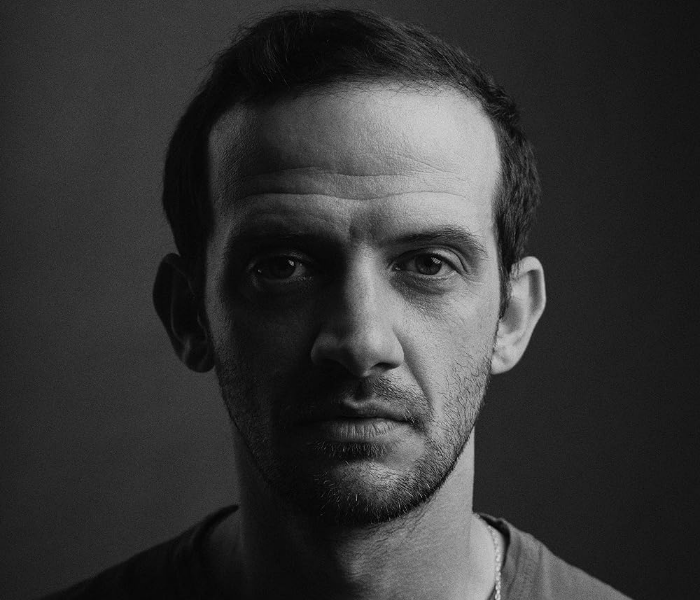
The newly minted Tony nominee talks about his long, personal journey with the hit play
—
Will Brill is so authentic as an alcohol-addled British bassist in Stereophonic, it’s hard to believe he’s an American who only picked up the instrument for the part. Of course he’s had quite a while to practice: He’s been portraying Reg for nearly a decade, ever since David Adjmi began working on his spellbinding play about the members of a fictional 1970s rock band trying to record their seminal album through a haze of drugs, drink, ego and toxic romance. After an acclaimed run at Playwrights Horizons last fall, the production has transferred to Broadway’s John Golden Theatre, where it’s been nominated for 13 Tony Awards, including a nod for Brill (along with four of his castmates).
Brill was actually in the room when Adjmi wrote the first few pages of the script at a New Dramatists workshop in 2015. The playwright predicted then that Brill would end up playing the part. “He had a psychic premonition,” says Brill, a versatile character actor best known for his work Off Broadway (A Case for the Existence of God, Tribes) and on TV (Roy Cohn in Fellow Travelers, the title character’s brother in The Marvelous Mrs. Maisel).
He workshopped Stereophonic on and off for years, but Brill never imagined the show would end up being a Broadway smash. “When we first started, we were five non-musicians in a school space,” he recalls. Director “Daniel Aukin gave us fake instruments—like a xylophone and a triangle and a broom—and I remember thinking, Well, clearly this will never be anything. This is insanity!”
Back then, even Adjmi seemed to view the project as a theatrical experiment. “I think he wrote it without any grand notions that this play would be a thing that would take him somewhere,” Brill says. “He really approached it as a technical challenge.”
That changed as the development process continued. It became clear that the show wouldn’t work unless the actors played their own instruments and sang the songs (written by Arcade Fire’s Will Butler) live. So, Brill and his cohorts learned how to play so they could fake being a real band. They are thrillingly persuasive.
Brill’s character, Reg, is the quintessential bassist. He’s not the star of the band—he’s not as flashy or loud as the lead singers or the guitarist or even the drummer. The introspective Reg is happy to blend into the background, except when he’s having a drunken meltdown or a darkly comic cocaine-fueled rant, often directed at his wife and fellow band member, Holly (Tony nominee Juliana Canfield).
Even though Reg often acts like a brat, inhabiting him isn’t child’s play. For much of the show, he is high, a challenge for any actor to portray convincingly. Throw in an English accent and a complex bassline and you’ve got a real gauntlet.
How Brill pulls it all off is a mystery, even to him. “I feel like there are a hundred balls in the air and I’m constantly thinking about one or two of them,” he says. “I’ve gotten better at not beating myself up about the other 98.” Emotionally, embodying Reg has left its mark. “It’s the hardest show I’ve been a part of,” he says. “And I didn’t really clock all of the reasons for it being so difficult at first.”
Like Reg, Brill has struggled with addiction. When people ask him how he plays such a compelling drunk, he responds that he’s had a lot of practice. “It’s kind of a joke but kind of not,” he says. “I know all about the self-loathing that accompanies it.”
Brill has been sober for two and a half years, but it wasn’t until his therapist brought up the parallels between him and Reg that he realized what the show was doing to his psyche. “It becomes a real mindfuck when you’re working on a character who so closely resembles your experience,” he says. Brill also went through “a very public, very drunken divorce,” just like his character does in the show.
“I felt very stupid for not having thought about that and very grateful that my therapist pointed it out because I was able to find a lot of peace afterward,” Brill says. He also credits his castmates and the production team for creating a “very cozy and very comfortable” working atmosphere. “It’s the only way you can do something that has this much heft and sadness and meanness,” he says. “If you’re going to do that in art, it has to be in a really soft, pillowy environment.”

Because the set is essentially a real music studio, with a soundproof room upstage where characters can talk without being heard when the microphones are off, the cast has moments of personal connection out of earshot of the audience. “There are whole conversations that go on in there that nobody is privy to,” says Brill. It adds to the play’s verisimilitude, but also allows the actors to chat and keep the mood light. “People leave notes to each other; people tell each other secrets,” Brill says. “We have all these little rituals that no one will ever know about except for us.”
Still, the play is so complicated to perform that they can’t miss a beat. “There’s no relaxing and saying, ‘Oh, it’s on Broadway now. We don’t have to worry about it,'” he says. “There is so much going on that I don’t have control over. I count on the rest of the people around me to buoy me up. There’s no Reg without the other people on stage.”
—
Stereophonic is frequently available at our TKTS Booths.
TDF MEMBERS: Go here to browse our latest discounts for dance, theatre and concerts.