
Why Jewish Representation on Stage Makes Me Kvell
With anti-Semitism on the rise, authentic portrayals of Jewish life are more important than ever
At age 14 on my first trip to New York City, I saw my first Broadway show: the musical Titanic. I still vividly remember the characters of Isidor and Ida Straus, the co-owner of Macy’s and his longtime wife, singing “Still,” expressing their eternal love for each other as the ship sinks. At the end of the number, Isidor stomped on a glass, a well-known custom at Jewish weddings. I was surprised. I had never seen something so immediately recognizable as Jewish in a show that wasn’t Fiddler on the Roof.
I don’t need shows to be about people like me to enjoy and relate to them, of course. As a suburban California teenager, I was obsessed with Rent even though I knew nothing about squatting in the East Village at the height of the AIDS epidemic. But as one of only a handful of Jewish kids at school growing up, I was always on the lookout for Jewish characters in books, movies and shows because they made me feel less othered. Those recognizable moments—a word in Yiddish or Hebrew, hora-like choreography, a borscht belt punch line—are comforting for me as a Jewish audience member, especially now with the surge in anti-Semitism.
When I saw the musical The Bedwetter, based on Sarah Silverman’s memoir about growing up different, depressed and Jewish in a goyishe community, I recalled my own adolescent struggles. Created by a trio of Jews—Silverman, Joshua Harmon and the late Adam Schlesinger—there were so many scenes I identified with, like when Sarah’s classmates noticed that she had more hair on her body than they did.
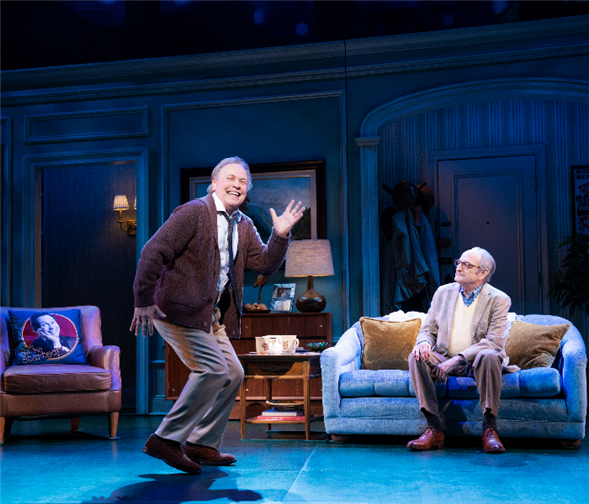
I love that Billy Crystal’s Broadway musical comedy Mr. Saturday Night exudes Jewishness throughout, from its old-school Catskills shtick to the kvetching of the central family, who constantly argue but with love.
These examples might come across as stereotypical or even offensive if they weren’t written and cast authentically. With lines like, “Life can still come through with a shocker even when you’re an alter kaker,” it’s no surprise that Mr. Saturday Night‘s many creators are Jewish, including book cowriter Crystal and songwriters Jason Robert Brown and Amanda Green. Fittingly, the actors playing Crystal’s family, Randy Graff, Shoshana Bean and David Paymer, are all kosher, too.
The musical Funny Girl is about famous Jewish jokester Fanny Brice, and original star Beanie Feldstein and her successor, understudy-turned-rising-star Julie Benko, are both members of the tribe. The Yiddishisms in the overhauled script (some added by Harvey Fierstein, also Jewish) came naturally to both performers, which was even more noticeable when compared to the decidedly shiksa Jane Lynch as Fanny’s mother.
While authentic casting is rightfully demanded for so many groups, non-Jews playing Jews often gets a pass. I get it, we are not underrepresented like artists of color or performers with disabilities. Still, sometimes it feels like the entertainment industry thinks Jewish women are more palatable when played by non-Jewish actors, a phenomenon Silverman and others have criticized as Jewface. (See Rachel Brosnahan in The Marvelous Mrs. Maisel.) Seeing unapologetically Jewish leading ladies on Broadway is validating. It’s going to be interesting when Lea Michele—who typically portrays Jewish characters but was raised Catholic—takes over as Fanny opposite legendary Jewish performer Tovah Feldshuh as her mama.
Other loud and proud Jewish shows I’ve enjoyed this year include Barry Manilow and Bruce Sussman’s Harmony, the true story of the Comedian Harmonists, a popular German singing group made up of Jewish and non-Jewish members who were torn apart by the rise of the Nazi party. It was powerful seeing the musical at the Museum of Jewish Heritage, where its themes echoed throughout the galleries as a reminder of what we’ve overcome and what we’re still fighting against today. Even though I didn’t live through the Holocaust, I know what hate looks like.
I also related a lot to Just for Us, Jewish comedian Alex Edelman’s solo show about how he infiltrated a meeting of white supremacists. No, I’ve never done that (and it’s not on my bucket list!). But he brings up issues I’ve thought about a lot, such as the ways I benefit from white privilege while still being an “other.” And there were certain lines like, “Judaism is the Hotel California of religions,” in that you can check out anytime but you can never truly leave, that resonated with me deeply.
Speaking of white privilege, it’s important to note that Jewish representation in theatre is still overwhelmingly white, which is a problem. As an Ashkenazi Jew, I see myself frequently reflected on stage. It was exciting to see Sephardic Jewish characters in both Prayer for the French Republic, Joshua Harmon’s epic about a French Jewish family, and Wish You Were Here, Sanaz Toossi’s play about a group of girlfriends in Iran. Here’s to more authentic representation of all kinds of Jews because we all deserve to feel seen.
—
TDF MEMBERS: At press time, discount tickets were available for Mr. Saturday Night and Funny Girl. Go here to browse all theatre, dance and music offers.
Linda Buchwald tweets about theatre at @PataphysicalSci. Follow TDF at @TDFNYC.
Top image: Billy Crystal and David Paymer in Mr. Saturday Night on Broadway. Photo by Matthew Murphy.