
Why It’s the Right Time to Revive ‘M. Butterfly’

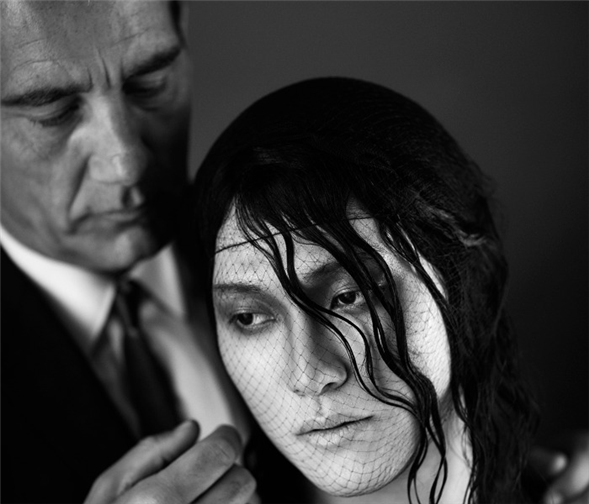
Tony winner David Henry Hwang discusses the new resonance of his 30-year-old play
—
Playwright David Henry Hwang believes it’s the perfect moment for M. Butterfly to return to Broadway. The drama about a French diplomat who claims not to know his longtime Chinese lover was a spy or male earned acclaim and multiple Tonys in 1988, making Hwang the first Asian-American dramatist to win the award. For years, Hwang was reluctant to agree to a revival because the highly theatrical staging by the late director John Dexter left an indelible impression. As Hwang explains, “If I was going to do it again, I wanted to create the possibility that the new production would not obscure the memory of the original, but at least allow for the play to maybe feel fresh again.”
It was the opportunity to work with fellow Tony winner Julie Taymor, the visionary director of The Lion King, that convinced Hwang to move forward. The production opens this week at Broadway’s Cort Theatre starring Oscar nominee Clive Owen and newcomer Jin Ha. “Julie is someone who I think has the same degree of theatrical verve that Dexter did, and certainly she has a brilliant visual sense,” Hwang says. “After we met I also realized how focused she is on character and narrative. We began to talk more about the script and about the original story, and that was incredibly exciting.”
M. Butterfly was initially inspired by a news item Hwang read about Bernard Boursicot, a French diplomat jailed for passing classified documents to a Peking opera singer who was spying for the Chinese government. Boursicot insisted that during their nearly 15-year relationship, he believed his lover was female. “I thought about the story for a year,” Hwang remembers. “Then the idea came to me that this diplomat thought he had found his version of Madame Butterfly.” M. Butterfly is the playwright’s witty and provocative deconstruction of that eponymous Puccini opera, as well as a revealing examination of how attitudes toward race and gender shape contemporary politics.
Even though Hwang wrote M. Butterfly three decades ago, he says it resonates now in ways he could have never predicted. “I mean it’s bad for the world and good for our show that the 2016 presidential election turned out as it did,” Hwang says with a rueful smile. “We are certainly living with the manifestation of this very same toxic version of masculinity and, of course, what it means to be dominant over women, and how that mentality gets applied to the world.”
While rampant sexism sounds depressingly familiar, one element of M. Butterfly that’s different today is the East-West dynamic. “The notion of the East as submissive is more complicated now,” Hwang acknowledges. “Thirty years ago, China was ascendant, but we were coming out of a period where the West was clearly dominant. At this moment it certainly appears that China is going to surpass the US as a political and economic power, so I think people look at the East-West issues through a slightly different prism. Interestingly, though, I think there’s a way in which the West — because we are so performatively masculine, particularly in America — still thinks of Asia as being female. When our president talks about China playing unfairly and claiming that Chinese dominance has taken place because they are fooling us, I think that falls into a kind of dragon-lady trope. So it’s different, but a lot of the same kind of gendering of the East-West relationship continues to exist, and has probably been exacerbated by the 2016 election.”
Speaking of male and female, gender identity — or more specifically, fluidity — has also evolved a great deal since M. Butterfly debuted. “A huge aspect of the original was its shock value,” Hwang says, referring to the play’s dramatic gender reveal. “I don’t know that it is so shocking today because I think we are much more aware of a range of gender expressions. [With the rewrites] we’ve tried to embrace that. It’s not about, ‘Gotcha!’ It’s more about looking at a relationship where one player is gender nonconforming.”
That said, this production does play with audience expectations and binary perception: Is that Madame or Monsieur Butterfly? “Hopefully that goes back and forth throughout the show until at a certain point, maybe it starts to blur,” Hwang says. “And then we realize, you know, maybe it doesn’t matter.”
—
TDF MEMBERS: At press time, discount tickets were available for M. Butterfly. Go here to browse our current offers.
Gerard Raymond is an arts journalist based in New York City.
Top image: Clive Owen and Jin Ha in M. Butterfly; photo by Josef Astor.