
Why Irish Rep’s Mounting of O’Casey’s Dublin Trilogy Is a Major Event
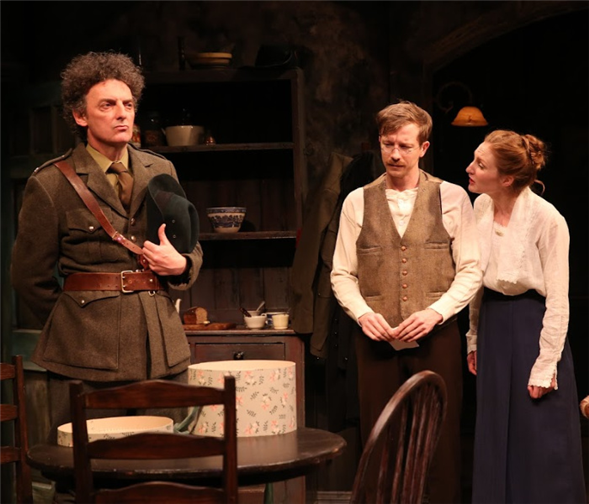
Artistic director Charlotte Moore talks about the company’s ambitious undertaking
—
It’s been about 60 years since Charlotte Moore, as a college student in St. Louis, discovered the work of Irish playwright Seán O’Casey. She took to him right away. “I was a rebel; he was a rebel,” she explains. “He used language the way I wished I could.” His extraordinary life story also intrigued her: O’Casey’s career as a professional dramatist began in 1923 when he was 43. Before that, he worked as a laborer. “He couldn’t even read or write until he was a teenager,” Moore says. “He had a terrible eye infection when he was a child and was nearly blind, so he was taken out of school. He was a late starter, but once he got started the fire in his brain and in his heart took over.”
The same might be said of Moore as a director. Three decades ago she was a busy Broadway actress when she decided to helm her first play, O’Casey’s The Plough and the Stars. That 1988 mounting marked the inaugural production of the Irish Repertory Theatre, which Moore, its artistic director, cofounded with producing director Ciarán O’Reilly.
In celebration of Irish Rep’s 30th anniversary season, the troupe is currently staging all three plays in O’Casey’s Dublin Trilogy in repertory. Together, The Shadow of a Gunman, Juno and the Paycock and The Plough and the Stars chronicle Ireland’s violent struggle for independence from the British in the early 20th century. At age 79, having now directed some 75 productions, including a second go at The Plough and the Stars in 1997, Moore was eager to once again helm the play that started her down this path.
“I think I probably have a better understanding of the play now,” she says. “I am older. I am more experienced. I have worked with Irish actors a lot more. Irish actors are the greatest source of truth and information when you’re doing a play like The Plough and the Stars.”
Most of the 16 actors currently in the company were born in Ireland, and the majority of them are appearing in all three plays. “Their fathers and grandfathers were alive and active and political during the period of these plays,” says Moore, which is why she “appreciates the political points in O’Casey’s plays more than I did 30 years ago.”
All three shows are set in Dublin tenements and focus on impoverished citizens whose lives are shaken up by the violence and strife of the era. The plays mix comedy with tragedy, and are filled with language that is rich and rhythmic, provocative and painful, spoken by barflies and blusterers, sensible women and passionate men, cynics and idealists.
O’Casey had been submitting scripts for some half dozen years to Dublin’s famed Abbey Theatre before its founders finally accepted The Shadow of a Gunman. Set during the 1920 Irish War of Independence, it tells the story of an aspiring poet who’s suspected of being an Irish Republican Army assassin by his neighbors. At first flattered by the rumor, he soon comes to realize how dangerous such gossip can be. O’Reilly directs the Irish Rep production.
O’Casey’s follow-up was Juno and the Paycock, set during the Irish Civil War in 1922. It focuses on a struggling family, who are told a distant relative has left them money. But the promised salvation actually leads to their destruction. The best known play of the trilogy, it’s had six mountings on Broadway and several screen adaptations. Neil Pepe helms the Irish Rep mounting.
The trilogy’s final installment, The Plough and the Stars, is set a decade earlier during the Easter Rising of 1916, as a pregnant woman tries to stop her husband from joining the fighting, which only succeeds in angering him. He takes up arms as Commandant of the Irish Citizen Army, and disappears, while she and her neighbors, a quarrelsome lot, wind up devastated by the urban warfare.
Much appeals to Moore about all of these works, but she is especially impressed by O’Casey’s female characters. “In the 1920s, the soldiers, politicians and statesmen were all male, but he finds the heart of his plays in the women,” she says. A memorable example in Plough is Bessie Burgess, who is portrayed in the Irish Rep production by Tony winner Maryann Plunkett. A street fruit vendor who is a British loyalist, she comes off as a loud and nasty drunk at first, but soon we realize that’s just her armor. “She has a great heart,” says Moore. “She is a woman with a son who she may have lost in the fighting. But when it comes down to it, when things really matter, she is there; she comes through. She is a striking, stunning woman — even with her troubles.”
Although Moore considers O’Casey “the defining Irish playwright of the 20th century,” she laments that today, his works rarely enjoy major revivals, certainly not on Broadway. To mount O’Casey’s Dublin Trilogy in rep is a rare and ambitious undertaking — even Irish Rep has never done the plays together before.
“He’s hard to do well,” Moore admits. “You need to respect the time and the period. The language is hard to get right. You do not want to stand up there and do it in a phony accent.”
The plays are also steeped in century-old history the average New York theatregoer probably knows little about, which is why the programs are filled with helpful glossaries, timelines and a page-long bio of O’Casey. For a more expansive overview of the playwright’s life and work, there’s an exhibition on the theatre’s second floor.
While it certainly deepens the experience, you don’t need all that context to understand the Dublin Trilogy. “You can load up on the background and the language, and I think that’s probably more fun,” Moore says. “But it isn’t necessary. In the end, it’s like Shakespeare. You don’t have to know everything about Italy in the 16 century to watch Romeo and Juliet, and you don’t have to know everything about the Irish troubles to watch these plays.”
—
Jonathan Mandell is a drama critic and journalist based in New York. Visit his blog at NewYorkTheater.me or follow him on Twitter at @NewYorkTheater. Follow TDF at @TDFNYC.
Top image: John Keating, Adam Petherbridge and Clare O’Malley in The Plough and the Stars. Photo by Carol Rosegg.
TDF MEMBERS: Go here to browse our latest discounts for dance, theatre and concerts.