
Why Does This Opera Have So Much Cursing?

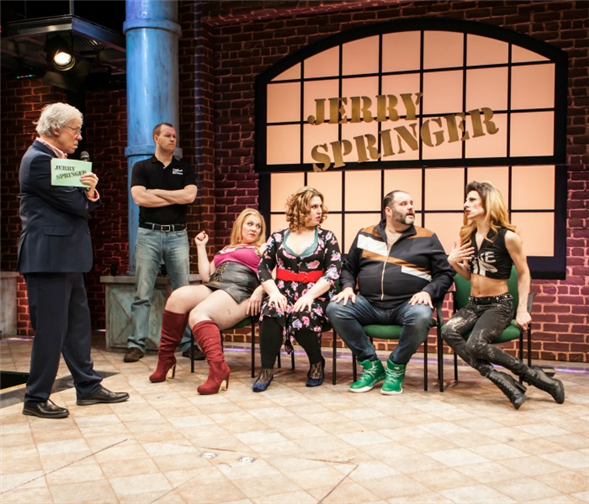
Jerry Springer – The Opera offers pathos and profanity
—
If it weren’t for the frequent streams of expletives, the choral refrains of Jerry Springer – The Opera might work at the Metropolitan. But given the raunchy subject matter and all those f-bombs, this musical is much more at home Off-Broadway, where it’s currently running at the New Group.
The brainchild of British writer and composer Richard Thomas, Springer was inspired by the infamous television talk show of the same name, which has been airing in syndication since 1991. “I was watching a particularly violent episode in the late 1990s,” Thomas recalls. “There were about eight people onstage screaming at each other. They were all being bleeped out and you couldn’t understand a word of what they were saying. I thought, God, this is like opera! I knew then I was going to have to write a show.”
The ensuing work, with a book and additional lyrics by Stewart Lee, premiered at London’s National Theatre and transferred to the West End, winning the 2003 Olivier Award for Best New Musical. A Broadway production was announced in 2004 but fell through. And while there was a two-night concert staging at Carnegie Hall in 2008, the New Group production marks the show’s full-fledged New York debut, with direction by Tony winner John Rando and starring Broadway veteran Terrence Mann as the titular TV host.
Lest you think this is just Springer in satirical song, the musical goes to some pretty thoughtful, fantastical, and emotional places. The first half emulates an archetypal episode, with Springer’s guests — including a philanderer, a scatophiliac, and an aspiring stripper with a racist husband — airing their dirty laundry as the audience eggs them on. The surrealistic second act finds the genial talk show host in Hell, arbitrating between Satan and Jesus, with God, Mary, Adam, and Eve as his bickering panel.
“I watched The Jerry Springer Show quite regularly because it was a phenomenon when it came out and I got slightly addicted,” Thomas admits. “I used to feel guilty about being complicit in this voyeurism. But I also used to find it very moving, especially early in the series.” Though critics dismissed Springer‘s guests as trash and fame whores, Thomas saw them as lost souls. That empathy comes through in the songs, notably “I Just Wanna Dance,” a soaring, heartrending ballad about unfulfilled dreams — even if that goal is to get on a stripper pole.
Although Thomas describes Springer as “a musical with operatic elements,” he leans heavily on the latter because it provides an intriguing dichotomy. “A character can be singing, ‘I hate you,’ but the music is saying, ‘I love you,'” he explains. “You are hearing two languages, which can be contradictory at the same time. I knew that the music would soften the edge and you’d get this delightful clash of joyous profanity.”
That classical bent works particularly well in the Hell-set second half. “When Jesus and the Devil face off, that’s pure Handel,” Thomas says before adding, “But I absolutely love musicals. My first musical was the film version of Fiddler on the Roof and my first live musical was Guys and Dolls at the National Theatre many, many years ago. It changed my life. So I’m quite happy flip-flopping in and out of classical and musical theatre.”
Given the source material and the interpolation of religious themes, it was inevitable that Springer would stir up some controversy. But Thomas believes the Christian groups who have protested and the theatre lovers who think it’s one-joke junk both have it wrong. “The note we always give actors is that you have to treat these people with utmost care and love,” he says. “If you just put a bunch of people onstage and laugh at them, it’s not funny. It’s just very mean, and I can’t see how you can sustain that for two hours. The thing that I found different about Jerry Springer was that he was genuinely nonjudgmental. At the end of episodes, his famous final thought was always, ‘Take care of yourself — and each other.’ I’m an atheist, but it’s like a Christian injunction. I think I’m on the side of the angels. It is a very moral piece.”
—
Gerard Raymond is an arts journalist based in New York City.
Terrence Mann, Billy Hepfinger, Beth Kirkpatrick, Florrie Bagel, Luke Grooms, and Sean Patrick Doyle in Jerry Springer – the Opera. Photos by Monique Carboni.
TDF MEMBERS: Browse our discounted tickets to theatre, dance, and concerts.