
Why Broadway’s New Louis Armstrong Musical Demands Three Directors

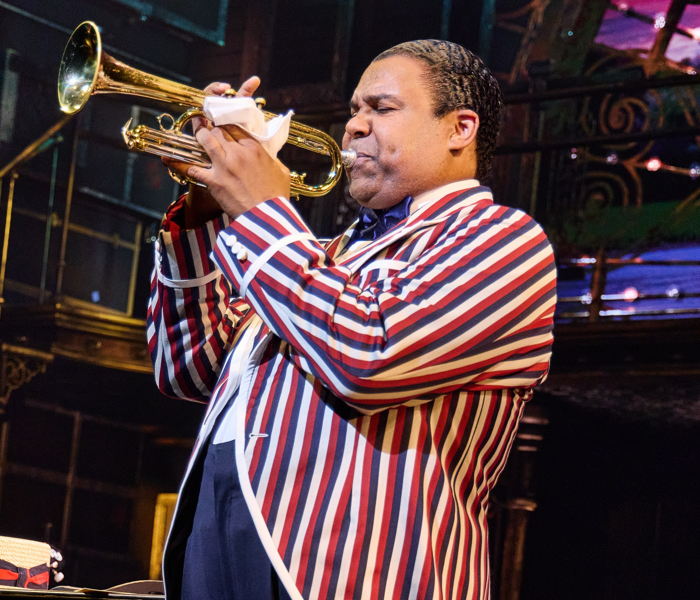
Tony winner James Monroe Iglehart, Christopher Renshaw and Christina Sajous talk about their rich collaboration on A Wonderful World
—
During Louis Armstrong’s five-decade career, the celebrated trumpeter and gravelly vocalist composed more than 50 songs, appeared in more than two dozen movies and recorded more than 80 albums. He was also married four times. Given those stats, it’s fitting that more than one director was needed to bring his life story to Broadway. A Wonderful World: The Louis Armstrong Musical, currently running at Studio 54, has three directors at the helm: Christopher Renshaw, Christina Sajous and the show’s star, James Monroe Iglehart, a Broadway favorite who won a Tony Award for his high-spirited turn as the Genie in Aladdin.
According to them, three’s not a crowd. In fact, they say the scope of the show, which chronicles Armstrong’s personal and professional triumphs and challenges in a racist society, demands multiple points of view. Renshaw, who co-conceived the musical with the late Andrew Delaplaine, directed its previous stagings in Miami, New Orleans and Chicago. But telling Armstrong’s story means telling the story of jazz, and Renshaw knew that called for collaborators with different perspectives. After the inaugural production in Florida, he hired Sajous, a busy stage performer most recently seen as the Acid Queen in Tommy, as his associate director in New Orleans and Chicago. Iglehart, who’s played Armstrong throughout the musical’s development, joined the directing team for the Broadway transfer.
“When the show was originally conceived, what excited me was the women,” Renshaw says, referring to Armstrong’s four wives, who anchor the four sections of the musical. “I personally feel that women, especially Black women, have not been given their due in relationships.” As a white British man, Renshaw wanted the input of “representatives of the culture. Because the show is so much about women and the way Armstrong learned from and reacted to them.”
Sajous agrees. “I think that’s what’s so wonderful about working on this show together, for all of us being able to fill in each other’s gaps.”
Beginning with Armstrong’s first marriage to Daisy Parker (Dionne Figgins), A Wonderful World shows how the women he loved helped guide his trajectory. It was his second wife, accomplished jazz pianist Lil Hardin (Jennie Harney-Fleming), who encouraged him to strike out on his own, while his third spouse, Alpha Smith (Kim Exum), supported him as he navigated white supremacy in Hollywood. He met his final bride, Lucille Wilson (Darlesia Cearcy), at Harlem’s iconic Cotton Club, and she remained by his side until his death in 1971.
In addition to his multiple marriages, A Wonderful World also explores racism in the entertainment industry and beyond, Armstrong’s run-ins with white gangsters, and his political stances and ensuing backlash. Such a wide-ranging story calls upon the co-directors’ different strengths.
“We find ways to use all of our talents in order to bring the show to life—not only broad strokes, but in meticulous detail,” Sajous says. “I think that’s where the three of us kind of thrive together, understanding what it is on a broad scale and seeing the concept as a whole, from the beginning, middle to end.”
Women’s roles in society, especially in the entertainment industry, evolved significantly throughout Armstrong’s life, and Sanjous sought to reflect those changes, from 1917 to the early 1970s. “I wanted us to highlight the importance of the women,” Sajous explains. “How do we keep them authentic and rich in his life, but also what was it like to be a Black woman in America at the time?”
Their investigations took on new relevance as they prepared for the Broadway run. While working to ensure that Black women of different eras were accurately represented onstage, they were struck by Vice President Kamala Harris’ history-making presidential campaign, which showed how far—and how not far—our country has come. Although Armstrong stayed publicly apolitical throughout much of his life, in 1957, when asked by a journalist what he thought about the treatment of the Little Rock Nine and the fight to desegregate schools in the South, he raged, “The way they are treating my people in the South, the government can go to hell,” and proceeded to sing the opening bars of “The Star-Spangled Banner” with profane lyrics. It was a fiery encounter that’s recreated in the musical. The scene still unsettles Renshaw.
“Every night he does it, it completely shocks me,” Renshaw says. “It shocks me that I’m involved in a show that dares to do that. Initially, when I read the script, I thought, well, I don’t think I can do that. Yet there he is every night. And it’s big stuff, it’s relevant, it’s dangerous, it’s fearless.”
Iglehart concurs. “Every time we do the scene, I say a line that means so much more to me in the last month: ‘It is not a crime for Negroes to be upset about America!’ Our country has changed so much, yet in certain things, we’re still infants.”
Armstrong’s underlying anger stands in stark contrast to his upbeat persona, and the directing team strove to portray that contradiction. Racism, cultural appropriation and social unrest are depicted between—and sometimes during—cheerful lyrics and exuberant tap numbers. Iglehart acknowledges that facing these moments as a cast was challenging.
“Our cast had to wrestle with it in order for us to be able to execute it,” Iglehart says. “We had uncomfortable conversations—’I don’t know if I can do this. I don’t know if I like being in that section’—but we explained, ‘Look, in order to tell our story, we have to tell our story.’ What I love about our show is that we weave really dark moments into the happiest songs in the world. We give you the truth, because that’s what we want, but at the same time, we want you to be left entertained.”
Those raw moments force audiences to reckon with the racism Armstrong experienced while smiling and delivering joyful tunes such as “Hello, Dolly!” and “What a Wonderful World.”
“When we go to a Broadway show, we have this jolly experience of being in a community effort and seeing a beautiful story,” Sajous says. “But I love that we dare or have the audacity to also challenge you to be uncomfortable in those very cushiony seats.”
—
TDF MEMBERS: At press time, discount tickets were available for A Wonderful World: The Louis Armstrong Musical. Go here to browse our latest discounts for dance, theatre and concerts.
A Wonderful World is also frequently available at our TKTS Discount Booths.