
Why Are These Grown Women Acting Like Teens?

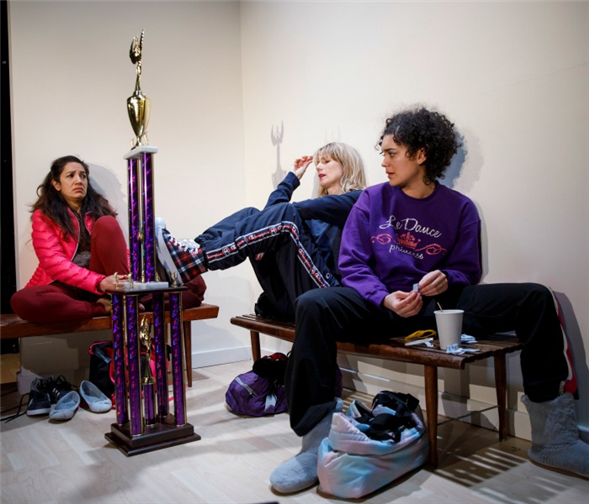
Off-Broadway vet Lucy Taylor unleashes her inner 13 year old in Dance Nation
—
In Clare Barron‘s new show Dance Nation at Playwrights Horizons, age isn’t a number, it’s a state of mind. The quirky one-act explores the camaraderie and competition among the female members of an adolescent dance troupe. Though they’re on the cusp of puberty, they’re played by a diverse cast of performers who range from their twenties to their sixties. So the actors channel the girls they once were while embodying the women these characters will eventually become.
Lucy Taylor, who falls somewhere in the middle of that age spectrum, plays Ashlee, the most confident of the bunch. She has a jaw-dropping, show-stopping, four-page monologue in which she not only owns her attractiveness and intelligence, she promises to wield them as weapons. Originally, the script specified that Ashlee was 14. But during rehearsals Barron, Taylor and director-choreographer Lee Sunday Evans realized that if she were just one year younger, the scene would feel more dangerous.
“It makes what she says sound a little bit more taboo,” says Taylor, who moved to New York from Australia in 2005 to join the award-winning avant-garde theatre company Elevator Repair Service. “There’s that line when Ashlee says, ‘I wish I could show you my ass but I’m only 13.’ There’s a big difference between 13 and 14. Fourteen feels so much older. At 13 Ashlee truly does have one foot in the tween camp and the other very much in womanhood.”
Although this production marks Dance Nation‘s official world premiere, the script has been kicking around for the past few years. In 2015, it won the inaugural Relentless Award (in a tie with Sarah DeLappe’s The Wolves), and it took home the Susan Smith Blackburn Prize last year. While some cast members have been with the show throughout its multiple workshops, Taylor is a new addition. “I had to do that four-page monologue for my audition!” she recalls. “It was really challenging. I actually did something completely different from what I am doing now. I changed my voice, I made myself sound like I was from a different planet. It was not naturalistic in any way, shape or form.”
Taylor’s initial instincts make sense since Dance Nation vacillates between verisimilitude and surrealism. The girls’ banter sounds authentic, but fantastical touches communicate the turmoil of being 13, such as when the dancers grow vampire fangs or use their menstrual blood as war paint. They’re at a point in their lives when they feel monumental and boundless one moment and insignificant and imprisoned the next, and Ashlee’s monologue encapsulates that dichotomy. “I love the idea of this girl saying, ‘I’m probably smarter and hotter than you,’ and believing it,” says Taylor. “But later, she’s ashamed of feeling that way. She’s at an age when she’s starting to grapple with all those insecurities. We pump our girls up with girl power and we tell them they’re limitless, yet we live within a limited society. What use is all that power if there isn’t a space to use it?”
Taylor, who is the mother of a 10-year-old son, says she and her castmates often get so caught up in the adolescent mind-set during performances, they’re startled when they spot their adult reflections. “There’s a scene when we have to look in the mirror and put our makeup on and we’re like, ‘Oh right, we’re not 13 at all,'” Taylor says. But that duality, the young soul emanating from the grown body, is what makes the show work. “I think if we had to consciously play the characters as the idea of what we think teenagers are like — the way they talk with the intonation that rises up at the end of sentences — we would get into trouble,” says Taylor. “We’re operating within the limits of our bodies and our voices. No one is attempting to play younger and I think that’s the key to why the play is so exciting. It isn’t really about teenagers; it’s about women.”
To read about a student’s experience at Dance Nation, check out this post on TDF’s sister site SEEN.
—
Raven Snook is the Editor of TDF Stages. Follow her at @RavenSnook. Follow TDF at @TDFNYC.
Top image: Purva Bedi, Lucy Taylor and Camila Canó-Flaviá in Dance Nation. Photos by Joan Marcus.
TDF MEMBERS: Go here to browse our latest discounts for dance, theatre, and concerts.