
What’s Next for Theatre Fans With Disabilities?
Lisa Carling on the future of theatre accessibility
—
This week marks the 25th anniversary of the Americans With Disabilities Act (ADA), which is designed to end discrimination against people with disabilities. To honor this milestone, I sat down with Lisa Carling, director of TDF’s Accessibility Programs (TAP), to ask her about the future of access and inclusion in the theatre. Here are the highlights of our conversation.
Mark Blankenship: TAP has been part of TDF for 35 years now, so there’s obviously a well-established history of making theatre more accessible to people with disabilities. But I’d be interested to know where you see your programming going in the future. What’s next?
Lisa Carling: I’d say our future is in two programs we have that are expanding rapidly. It’s been so rapid that we know they’ve sparked some kind of fire.
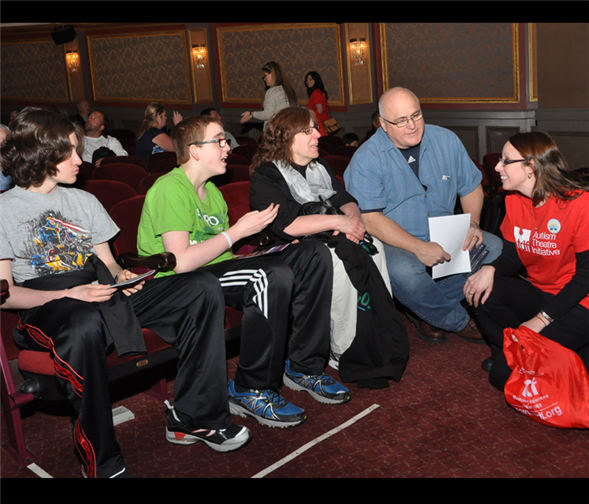
One of those is the Autism Theatre Initiative. We started our autism-friendly performances five years ago without knowing the impact they would have, and it’s snowballing. We keep selling out here in New York, and more and more theatres around the country are interested. That’s where our National Autism Theatre Initiative takes on importance as a resource for other theatres.
MB: Here in the office we all get really enthusiastic about ATI and the way it seems to impact everyone who comes close to it, from artists to audience members to volunteers. From your perspective, why do you think the program has caught on with people on the autism spectrum and their families?
LC: It’s a huge, neglected audience. There’s such a hunger out there for families to feel that they can do things together, that they can have something close to a typical day the way other families can. They want to see a Broadway show that their neighbors have seen. Everybody wants that option to do things that other people do.
MB: That makes sense to me. And I’m assuming the other program that’s expanding is open captioning, which uses electronic text on the side of the stage to display what actors are saying.
LC: Yes, it just continues to grow, and it just continues to serve people with hearing loss. Part of that is through our National Open Captioning Initiative, which takes open captioning to theatres across the country, and again, it’s a question of growing audiences. There are now 48 million people in the United States with some kind of hearing loss.
MB: It seems like technology is evolving with captioning performances, too. At least, that’s how I understand the conversations I hear around the office.
LC: That’s right. I think we’re going to see some great voice recognition software to help with captioning. And always, the thinking is, “How can we make performances accessible on a more regular basis?” That’s why we are very excited with a theatre accessibility website that we hope will be launching in a few weeks. It’s a combined effort between the Broadway League and TDF to get together a comprehensive list of all the Broadway shows and all the accessible performances they have coming up. And in a user-friendly format, which is just such an important part of it.
MB: And my last question: You’ve been part of the accessibility community for quite a few years now, and I’d be interested to know what keeps you fighting the good fight. What keeps you invested and involved?
LC: There’s always something more that needs to be done. The 25th anniversary [of ADA] is wonderful, but I think we’re all in situations where we might go somewhere – a hotel, a restaurant, a performance – and it might occur to us, “This isn’t really an accessible space.” We’re not quite there yet in having everything perfect, and maybe we never will be. But now after 25 years, people know there’s something that needs to be done, that should be done. They know you can ask for it if it’s not there. And I want to keep it in the forefront of people’s minds that spaces need to be accessible to people with a wide range of disabilities. It’s not only the law: It’s the right thing to do.
—
Mark Blankenship is the editor of TDF Stages
Photos courtesy of TDF’s Accessibility Programs. Top photo: A volunteer talks to the audience during an autism-friendly performance.