
What’s It Like to Play Tom Stoppard’s Alter Ego?

Actor Arty Froushan and director Patrick Marber on the personal nature of Leopoldstadt
A hand-drawn family tree is a potent recurring image in Leopoldstadt, Tom Stoppard’s elegiac new play tracing four generations of a wealthy Viennese Jewish clan during the first half of the 20th century. Threaded with recognizable strands from Stoppard’s own family history, Leopoldstadt may be the 85-year-old English dramatist’s most personal piece to date. It certainly feels different from the witty, erudite, fact- and wordplay-packed works the four-time Tony Award winner is famous for, like The Real Thing, Arcadia, Rosencrantz and Guildenstern Are Dead and the Coast of Utopia trilogy.
“I think it is a very cathartic thing that Tom has written—to put his own personal quest for self-knowledge on stage.”
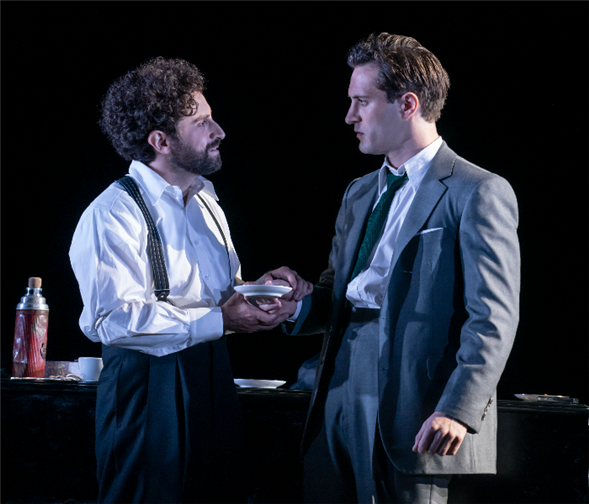
Currently running at Broadway’s Longacre Theatre, Leopoldstadt is named after Vienna’s Jewish quarter and received the 2020 Olivier Award for best new play in London. As he did across the pond, Patrick Marber directs an ensemble of more than three-dozen actors, mostly new additions (including Tony nominee Brandon Uranowitz, Caissie Levy, David Krumholtz and Seth Numrich), plus a few imported British players such as Arty Froushan, who portrays the grown-up Leo toward the end of the epic. Essentially Stoppard’s stage avatar, Leo flees the Nazis with his family and ultimately becomes a smug young Englishman. “Leo has lived this very ‘charmed life,’ as he says in the play,” explains Froushan. “His stepfather has brought him up to be a proud Englishman to the extent that he completely identifies as being English, very much at the expense of his Austrian heritage and also, crucially, his Jewish heritage.”
For those who’ve read Hermione Lee’s biography Tom Stoppard: A Life or Maureen Dowd’s recent New York Times profile of the playwright, this may sound familiar. Like Leo, Stoppard arrived in England at age 8 and took his stepfather’s surname, thereby shedding his Tomáš Straussler Czech identity. However, Stoppard was almost 60 when he began examining his Jewish roots thanks to a distant relative who drew him a family tree. Leo starts his journey of self-discovery as a much younger man.
Froushan joined the cast of Leopoldstadt last fall, when the play was remounted in London after its premiere engagement was cut short by the pandemic in March 2020. With only one other professional theatre credit since graduating from the London Academy of Music and Dramatic Art (though plenty of TV and film roles), the 29-year-old actor sees Leopoldstadt as a career milestone. “It is rare that you get to do a job that has such meaning and such import,” he says. “A lot of the stuff I do is swinging a sword around and jumping on horseback,” he adds with a laugh, referring to his upcoming appearance as a dashing knight in HBO’s new series House of the Dragon.
Like many of his costars, Froushan plays multiple roles in Leopoldstadt. Earlier in the intermissionless, two-hour production, he portrays Fritz, a cocky gentile cavalry officer circa 1900, who brutally drives home the prevalent anti-Semitism of the era. “I think most actors will tell you that playing villains is one of the delights of the job, and the scene is deliciously written,” he says. “But there is the challenge of not making it one-dimensional—the evil Aryan antagonist.” Leo, on the other hand, is “extraordinarily critical to the play and ends up embodying the essence of what drives the story.”
“I think it is a very cathartic thing that Tom has written—to put his own personal quest for self-knowledge on stage,” the actor continues. Interestingly, as an author’s self-portrait, Leo is not a particularly flattering picture. Froushan says he regards the character as a kind of “fictional cipher,” not a clear-cut Stoppard stand-in. He is certainly not attempting to impersonate the playwright. “I’d like not to think of the pressure of portraying him too much—he is one of the titans of British theatre!” he says, adding he never discussed the character with Stoppard. But Froushan has drawn some inspiration from Stoppard’s early years of fame. “Tom cut a very Mick Jagger-ish figure,” he observes. “I’m trying to access some of his rock-and-roll brilliance. But he also has a debonair quality to him, which I think is in Leo. I try to bring those two things together really: the intellect and the kind of cool man about town.”
While Marber, the director, admits Leopoldstadt may seem more overtly personal than Stoppard’s other work, he believes it’s in keeping with his entire oeuvre. “For me as a Stoppardian, I don’t feel Leopoldstadt is radically different from his other plays—I think all plays are personal,” says Marber, who is an award-winning dramatist in his own right (Closer, After Miss Julie). All playwrights “write in disguise,” he explains. “We are revealed in every character we write. I think the character of Henry in The Real Thing, which is about divorce and the pain of betrayal, is so absolutely Tom. Arcadia is full of him!” The difference here, Marber notes, is that Leo’s arc evokes Stoppard’s own exploration of his heritage. “Leo is a bit Tom-ish, and it seems as if Tom suddenly put himself on stage. And, of course, he has… and he hasn’t. He is a magician.”
Acquaintances and colleagues since the mid-1990s, Marber and Stoppard became friends when the former directed a revival of the latter’s playful pastiche Travesties, which transferred to Broadway in 2018. “I knew he was desperate to write a new play at that time, and I remember standing on 42nd Street outside the American Airlines Theatre in the interval when he said to me, ‘I think I’m onto something,'” Marber recalls. Months later, Stoppard told him that the new play was about “being Jewish, among other things.” That’s when he asked Marber to direct it. “It’s been a thrilling ride,” Marber says. “I’ve been with it every draft, reading scenes with him in his kitchen; I’ve been able to watch ringside a great playwright create a play.”
Leopoldstadt may have sprung from a personal catharsis for Stoppard, but the play resonates far beyond its creator. “For my father who is from Iran, it’s the same story,” Froushan says. “It was an extremely attractive proposition, particularly for his generation, to become British citizens. This triumphant culture was more attractive than one’s own identity.”
Because of his father’s expatriation, Froushan feels a “strange, distant connection” to a heritage that has been “kind of whitewashed by my Englishness and very traditional English education… There’s a kind of universality about someone who has this sort of amnesia about his origins and has come to totally embrace and identify with a new culture.” The kind of conversations that Leopoldstadt sparks about identity “are particularly salient at the moment.”
Marber agrees, noting that the play’s relevance seems to have grown since its 2020 premiere. “With its interests and its inspiration, whether it’s a refugee, an asylum seeker—to travel and not know your home—all these things are sadly still very relevant in our modern world.”
—
TDF MEMBERS: At press time, discount tickets were available for Leopoldstadt. Go here to browse all theatre, dance and music offers. The show is also frequently available at our TKTS Discount Booths.
Gerard Raymond is an arts journalist based in New York City who’s a member of the Drama Desk and the American Theatre Critics Association.
Top image: Brandon Uranowitz and Arty Froushan in Leopoldstadt on Broadway. Photo by Joan Marcus.