
Tony Kushner on Theatre in America

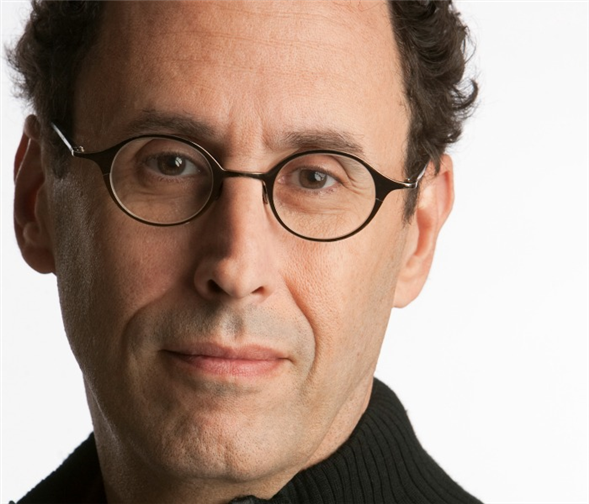
The playwright talks Angels, access and the future of culture in this country
—
It’s a year of meaningful theatre milestones: TDF is turning 50 as Tony Kushner’s magnum opus, the two-part, Pulitzer Prize-winning epic Angels in America: A Gay Fantasia on National Themes, enjoys its 25th anniversary production on Broadway. We are thrilled that he agreed to be our honoree at TDF’s upcoming 50th Anniversary Gala so we can celebrate together and look toward the future as the great work continues. In advance of the event, the bold, no-holds-barred playwright chatted with TDF Stages about the high cost of culture, his dream for an American National Theatre and where he goes to find inspiring new plays.
Raven Snook: Angels in America has earned 11 Tony nods, making it the most-nominated play ever. Although it’s a deeply American work set in ’80s New York during the AIDS epidemic, this production was imported from London’s National Theatre. Were you surprised that its first Broadway revival came by way of England?
Tony Kushner: Not really because that’s the way it made it to Broadway in the first place. The National asked to do a production of [Part I] Millennium Approaches in 1992, and it got great reviews and became this big thing in London. That created a kind of frenzy about it here. It didn’t have to happen that way the first time, and possibly not this time either. But it was mostly a matter of timing. I give [producer] Rufus Norris and [director] Marianne Elliott and the National a lot of credit for sensing this was a particularly good time to bring the play back, which it’s turned out to be. Both in London and here it feels like it’s very much speaking to this moment. Whether it would have felt that way if Hillary Clinton was President and the world wasn’t on the brink of the abyss, I don’t know. I would happily trade this production to see Hillary Clinton as President instead of the monstrosity we have right now. Whatever the case, the play is working very well.
Raven Snook: We’re all wary of the ever-escalating cost of theatre tickets — I know producers for Angels in America recently launched an initiative to offer $5 seats to various LGBTQ and HIV/AIDS organizations. Is financial access to theatre something you feel strongly about?
Tony Kushner: I think it’s a huge obstacle for a lot of people, how much it costs to see a show. And it makes being in the commercial arena especially problematic because you’re aware that there are a lot of people who, in my case, are sort of the natural audience for my work, who are going to find it difficult to get in. Any way that it can be made more accessible is really necessary. I think there’s still some huge piece missing in terms of the way we create theatre in this country: the cost of it and lack of government support for it and the limitations that imposes on what’s available. So it’s something that I care about.
Raven Snook: Where do you go to find new theatre that excites you?
Tony Kushner: I mean in terms of cities — and maybe I shouldn’t say this — but New York is still the theatre capitol of the universe. I see so much exciting, innovative, thrilling work on a regular basis. The two theatres that I have the deepest professional connections with in New York are the Public and New York Theatre Workshop. Between those two theatres, that’s where all of my work has been done. So if I go to the Public or the Workshop I’m almost certain to see extraordinary acting, extraordinary directing, extraordinary new playwriting. But I’ve also seen that at Playwrights Horizons and I’ve seen that at Lincoln Center Theater and I’ve seen that at Manhattan Theatre Club. I’m not dodging the question, really! There’s also Soho Rep, where I first saw An Octoroon, Branden Jacobs-Jenkins’ play, which blew me away. One of the greatest things I’ve ever seen in my entire life was David Greenspan at the Transport Group do his one-man version of Strange Interlude — the entire play! He has to bring it back. Wherever you go in this city people are doing absolutely extraordinary things. I went over the weekend to see The Band’s Visit (I hadn’t seen it at the Atlantic) and I was just floored by it. I mean the subtlety of it and the complexity of it — they did a number of things that I don’t think I’ve ever seen in a musical before. It’s an amazing time to be in American theatre. I think for a while now it’s been a kind of golden age of playwriting. There’s so much extraordinary work that’s being done.
Raven Snook: Many say we’re also in a golden age of television, with all these new platforms allowing writers to create epic series. A lot of them started out as playwrights. Do you worry better-paying screen work will take them away from the theatre?
Tony Kushner: Honestly I worry about that for myself! I spend more time now writing screenplays. I’m a slow writer — I have a very elephantine process, so I can’t write two plays and a screenplay every year. I mean, I spent seven years working on Lincoln. I think I’ve actually gotten pretty good at being a screenwriter and I really enjoy it, but I will always think of myself as a playwright. It’s difficult: If you have a play on Broadway and it’s showing well you can make a great deal of money. But ordinarily, you know, it’s very hard for playwrights to make a living just from writing plays. I mean a decent living and, of course, we don’t have health insurance. My health insurance is through the Writers Guild so I need to keep writing screenplays for that reason and others. So I do worry about it, yeah. And yet I think that Annie Baker is a playwright. Suzan-Lori Parks is a playwright. I am a playwright. I think that playwrights are always going to be playwrights. We may write good movies (or bad movies) but we’re always going to come back to this form.
I think it’s actually much more difficult for actors to devote a substantial part of their life to stage work like Nathan Lane has done. Nathan, of course, is a Broadway star. But there are a lot of other people who are extraordinary actors who mostly do stage work. And you need those people if you’re going to do theatre because they’re the ones who know how to do it eight times a week. Broadway will pay you a very decent wage. None of the [Off-Broadway] nonprofits in New York pay living wages to actors. That’s a terrible problem — they have it worse than playwrights do. And yet the only thing I can say is that theatre, “the fabulous invalid,” has always been threatened by all sorts of things since Aeschylus, and it’s absolutely indestructible. It will always come back because it’s so essential. So I’m not too worried about it.
Being back on Broadway has rekindled a dream I used to have back when Angels was there the first time. It’s so thrilling to be in one of those houses. They’re so beautiful designed. They should take out some of the extra seats that all the theatre owners have jammed in but, apart from that, they’re absolutely perfect proscenium houses. And there should be a few of them at least in and out of which new American plays are constantly streaming. There are all these really wonderful revivals this season but very few new plays have made it to Broadway. Being in one of those houses connects you to the history of American theatre. Angels is playing at the Neil Simon, which used to be the Alvin, which is where Ethel Merman had her stage debut. It’s thrilling to me to go into that theatre and say, “Oh wow, Ethel Merman was here!” I wish we could use eminent domain and lay hold of two or three of the smaller dramatic houses and just turn them into the American National Theatre. Every play’s in for six weeks and then out, with low prices for tickets and high salaries for actors.
Raven Snook: That’s quite a spectacular dream, especially considering Broadway has, for many, become synonymous with musicals. They’re what people clamor to see, with Harry Potter the only play that garners the same level of interest and attention. At TDF, we talk a lot about audience building. How do we indoctrinate the next generation of theatregoers, and how do we inspire current audiences to expand their appetites and take more chances? It’s an ongoing battle.
Tony Kushner: It’s a great fight that I think is worth having. If you’re going to try and sell tickets on Broadway to a play, you have to have a movie star — which isn’t necessarily a bad thing. Look at Denzel Washington: He’s one of the greatest actors who ever lived so nobody could ever complain about seeing him on stage. But if you happen to have a production that doesn’t have a star, you start out immediately struggling. There’s somewhere between 60,000 and 80,000 serious theatregoers in New York who will find some way to see the shows they want to, even if the ticket prices are high. But once you burn through them, you’re into a wider circle of people who need some convincing. A big musical doesn’t require a lot of that; a dramatic play is a whole other thing.
Raven Snook: I do get jealous of the support the arts get in other countries, especially in Europe.
Tony Kushner: Not for long! Talk to British theatre producers and they’re all fighting shrinking budgets and austerity. Same for the symphony orchestras and the dance companies and the museums. The notion of the centrality of culture to society has really slipped a lot. It’s grim. But I don’t feel depressed. I believe we’re going to get to a point — it’s taking a long time, but it usually does — where these idiotic culture wars don’t have to be fought any longer. When, I assume, it will be possible for a progressive, centrist President and a progressive, left-leaning Congress to actually create a fully funded National Endowment of the Arts that pumps serious money into culture. That day is not imminent, but I don’t think it’s centuries away either.
Raven Snook: You are an optimistic man, just like Angels is, ultimately, an optimistic work. There’s that oft-quoted line at the end, “the world only spins forward,” that idea of progress. Do you hope the production inspires change? That it’s a political call to arms of sorts?
Tony Kushner: I think a call to arms has to be a call to arms. You have to have a plan in place that you’re calling people to, which is not the case here. But I think it’s an invitation to hope — that would be the best way to describe it. I think it’s a good thing at this particular moment when there are so many loud voices on the other side inviting us to despair.
Raven Snook: You went to university in New York City. We’ve been collecting TDF and TKTS memories in honor of our 50th birthday. Did you used to wait in line for cheap seats?
Tony Kushner: When I was in graduate school at NYU, that was how we went to see things. That or standing room, which I think was $2.50! There was always this excitement at the TKTS line about what was available. I remember standing in lots of lines then, for Shakespeare in the Park, for movies. As a culture, we’ve to a certain extent lost the community-building exercises of standing in long lines with people who are all there to do the same thing that you’re there to do.
Raven Snook: Angels in America is currently available to TDF members, and I’ve been thinking about taking my 13 year old since I don’t want her to have to wait 25 years to see it on Broadway again. At TDF we run multiple education programs that bring New York City teens to theatre. What are your thoughts on young audiences seeing a grown-up show like Angels?
Tony Kushner: I’m all for it. There are a lot of high schools that read the play. And cousins of mine brought their 11 year old, which I thought was way too young. But he liked Part I so much, they had to buy him a ticket to see Part II.
Raven Snook: That’s inspiring to hear. I believe a key part of raising the next generation of adventurous theatregoers is exposing kids to shows that might be a bit beyond their grasp. It challenges them and keeps them curious. What’s the worst that could happen? That my kid turns to me at the end of Angels and says, “I don’t get it?”
Tony Kushner: If she does say that, tell her I’m right there with her!
This conversation has been edited for length and clarity.
Click here to purchase tickets to TDF’s 50th Anniversary Gala, which takes place at Gotham Hall on Monday, June 18.
—
TDF MEMBERS: At press time, discount tickets were available for Angels in America Part I: Millennium Approaches and Part II: Perestroika. Go here to browse our current offers.
Raven Snook is the Editor of TDF Stages. Follow her at @RavenSnook. Follow TDF at @TDFNYC.
Top image: Tony Kusher. Photo by Joan Marcus.