
This Play Dares You to Leave… or Stay
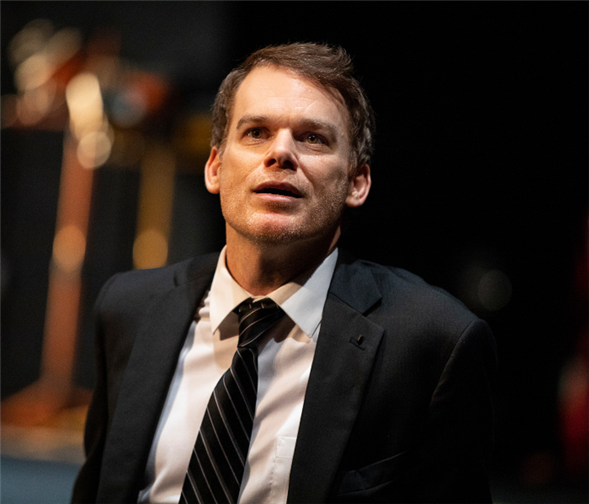
After 13 years, Will Eno’s funny and unnerving monologue Thom Pain returns with Michael C. Hall
—
Although dramatists are not necessarily the characters they write, there are many compelling reasons the title figure in the monologue play Thom Pain (based on nothing) seems like a Will Eno self-portrait. Eno and Pain are both dryly funny fellows, with a skewed view that’s at once cosmic and mundane. When they speak, both comment on their own language — undercutting, annotating, contradicting. The solo piece originally played Off-Broadway in 2005; now it’s being revived by Signature Theatre Company with Dexter star Michael C. Hall as Eno’s alter ego. Those who come because they’re fans of the actor are in for quite a surreal ride. As Eno admits, “There are a lot of entry points in the play. I’m sure there are a lot of exit points, too.”
Thom Pain isn’t what you’d call an audience pleaser. It tests the spectator’s patience with a prickly, rambling, derisive everyman who doesn’t seem to know why he’s there or why we bother to stay. He connects and disengages in a single breath. “I see no separation, no unbridgeable distance between us, wonderful us,” he rhapsodizes. “Or none worth remarking, since the thought of you disgusts me so much. The thought of you doesn’t disgust me that much. In fact, you’re all so wonderful I’d like to take you home, leave you there, and then go somewhere else.” At another point he makes a blithe reference to “our little performance, our little turn, on the themes of fear, boyhood, nature, hate, the nature of performance and vice versa, the heart of man, of woman, et cetera.”
Those are indeed the weighty themes of Thom Pain, but listing them in such a deliberately banal fashion undercuts any attempt to interpret the work, in which not much happens besides a lot of talking. Through the collage of childhood trauma, doomed relationships and jokes about narrative conventions, we try to follow the thread of the narrator’s morbid thinking. Periodically, Pain will turn to a woman in the audience and express profound love for the stranger. Passion, heartbreak and death are the biggest punch lines in this existential comedian’s set.
“The play is my experience of trying to integrate myself into the world through my mom and my dad, and other people, by way of language,” says Eno, a father himself to a young daughter with actress Maria Dizzia. “It’s about trying to integrate that left and right brain. You’ve got all these huge, oceanic feelings on the right side, and you’ve got language and linearity on the left side. A parent can help a child to move those oceanic feelings a little bit over to the other side, to organize them in a coherent and meaningful order.” Yet Pain “reads like a person who has two very developed halves of a brain, but these oceanic feelings seek a meaningful order, a narrative linearity.” As Pain says in the play: “I’m trying. A trying man. A feeling thing, in a wordy body.”
The first performer to animate this “wordy body” was indie-film actor James Urbaniak, who premiered the piece at the Edinburgh Festival Fringe in 2004, then traveled with it to London and eventually Off-Broadway’s DR2 Theatre. Reviews were mostly ecstatic, and the show ran eight months. This revival is staged by Oliver Butler, who first directed the play two years in Los Angeles with The Office‘s Rainn Wilson, who shared an apartment with Eno long ago. “We both cheered each other on when we were just starting out,” the playwright recalls.
Since those early downtown days, Eno, who’s 53, has gone on to a solid career as one of his generation’s most elegant and incisive experimental voices. He’s had a play on Broadway, The Realistic Joneses, featuring Hall alongside Toni Collette, Tracy Letts and Marisa Tomei; and Thom Pain has, by his estimation, been translated into about 20 languages. In 2017, the playwright completed his residency at Signature Theatre, which presented Title and Deed, The Open House and Wakey, Wakey over the course of five years. Thom Pain marks his first Signature Legacy production.
Eno is full of admiration for his current leading man, which is good since Hall is portraying the playwright — more or less. “He’s close to fearless as a performer,” Eno says. “There’s an incredible amount of confidence and bravado that comes with that, but he’s just got this incredible humility and vulnerability.” I point out that as a guy who beat Hodgkin’s lymphoma into remission a few years back, Hall seems at home with Thom Pain‘s neo-Beckettian gallows humor. “I get the sense that he may have done a lot of work on himself,” Eno says. “But I also get the sense that that’s just him. That’s how he’s faced the difficult things in life.”
Although the play may poke fun at the idea of bravery in the face of agony, Eno clearly believes that things can get better. You fall in love, you have a kid, your plays get produced… and then you die. At least you lived first.
—
David Cote is a freelance theatre writer and critic with bylines in Observer and American Theatre, and an opera librettist and playwright. Follow him at @davidcote. Follow TDF at @TDFNYC.
Top image: Michael C. Hall in Thom Pain (based on nothing). Photo by Joan Marcus.
TDF MEMBERS: Go here to browse our latest discounts for dance, theatre and concerts.