
Talking to Stephen Schwartz
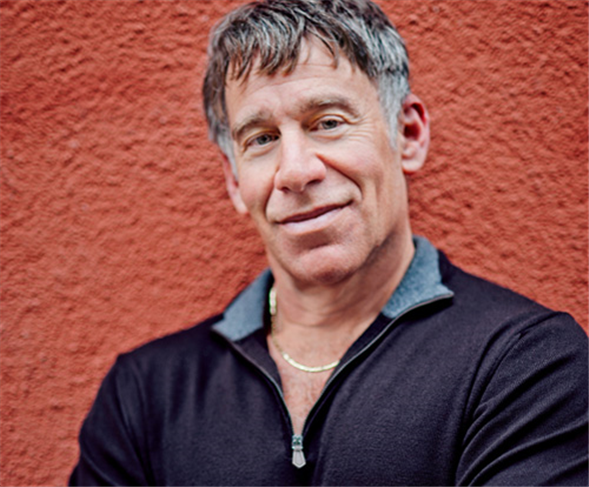
By MARK BLANKENSHIP
Stephen Schwartz is one of the most influential forces in contemporary musical theatre. As a composer and lyricist, he’s created classics shows like “Pippin” and expanded the American songbook with tunes like “Meadowlark” and “Day By Day.” At the moment, two of Schwartz’s defining works—“Godspell” and “Wicked”—are running next door to each other on Broadway, and he’s collaborating with Aaron Sorkin to create a musical about Houdini. Since Hugh Jackman is attached to play the legendary magician, there’s a good chance Schwartz will be celebrating yet another hit in just a few months. Last week, Schwartz joined me for lunch in midtown Manhattan. We discussed his lengthy career, his thoughts on his current Broadway shows, and how being a team player doesn’t always mean what you think. I’m delighted to present the highlights from our conversation. — Mark Blankenship —
TDF Stages: Godspell, which stages the teachings of Jesus with a rock-pop score, has been produced thousands of times since it premiered Off Broadway in 1971, but until the current revival opened last fall, it hadn’t been on Broadway in over thirty years. What’s it like to have your first hit back in the spotlight?
Stephen Schwartz: When the idea of doing Godspell again came up, I felt that what Godspell is actually about is in some ways more timely now, perhaps. Or it’s timely in a different way. Because there are so many people making statements in the name of this particular… whatever you want to think of him as. If you want to think of Jesus as God. If you want to think of him as a philosopher. However you want to think of him. One of the things about Godspell is it doesn’t really take a position on that, unlike other artworks that deal with the character of Jesus. They tend to take a religious position. And Godspell is about the philosophy expressed. If you actually listen to what he said, or at least as reported by the people who wrote the Gospels, and then you hear what people who are claiming to be speaking in his name are saying, there’s a big disconnect there. What they’re talking about is completely different, and in some cases, it’s diametrically opposed to what he actually said. And when I went to see the production at Paper Mill a couple of years ago, I hadn’t seen the show for a long time. I found myself listening to the words again. [Director Daniel Goldstein, who’s helming the Broadway revival, also directed the show at New Jersey’s Paper Mill Playhouse in 2006. – Ed.] When it’s your show, and you’ve written it and rehearsed it and seen umpteen thousand productions of it, you’re kind of just chanting along in your head. You’re not really thinking of words as words anymore. But I suddenly heard those words again and was kind of startled by how revolutionary they sounded.
TDF: Was there a particular moment that felt fresh?
Schwartz: In the sheep and goats parable, when [Jesus] says, “Whatever you did for someone here on earth, you did for me. Whatever you did not do for one of your brothers or sisters here on earth, you did not do for me.” Which is essentially the core of his philosophy. And in the context of today’s politics, that sounded kind of revolutionary. [Which is not to say] it’s a Sunday school lesson or that it’s meant only to deal in those terms. The show is essentially about the formation of a community, which is another thing we seem to be having a lot of trouble doing in America right now. So it felt as if it had a contemporary raison d’etre.
TDF: Beyond the relevance of the message, the show is also being staged in the round at Circle in the Square.
Schwartz: That felt like a really fresh way to approach it. I felt like it was really firmly based in the original concept and point of view of the show, yet finding a whole new way to stage it. That was exciting and fun to work on. Not that I did that much work, to be perfectly honest. Essentially, they did their production and from time to time, I would drop in and say, “Oh, I think you’re missing a beat here” or “Oh, I’m not sure you’re really doing what you think you’re doing there.” But essentially they did their production.
TDF: That’s an interesting role to play: Someone who stands outside the show and offers thoughtful responses to the rest of the creative team.
Schwartz: I tend to try to do that, even on a new piece. It’s why I don’t actually like to be at rehearsal unless the director insists on it. I really like to stay away and come, when invited, to see a run-through. Because I feel that I can be very objective about what’s there. I don’t know the reasons that choices have been made. I don’t know that they’re doing something because they couldn’t make the costume change, or they staged something some way because somebody was afraid of twisting his ankle. I just see what’s there, and I can say, “I don’t get it.” Or, “I don’t think you’re doing what you think you’re doing in this moment.” I’ve been told by directors that that’s very helpful to them, because they, by the nature of what they do, have to lose their objectivity all the time. [As a director,] you’re there every day, and you’re making choices based on day-to-day realities, and you can’t entirely see what the effect of that choice is on the piece. So I think it’s helpful for me, as someone who’s on the side of the piece, to be able to provide that objective response.
TDF: You said you try to do that when a show is brand new. Can you stay objective when you’re in the midst of writing something?
Schwartz: If you’re a writer on a new piece, that’s much, much more difficult to do. Because you have your own preconceptions. No matter how much you like the director and ultimately like the show, the first time you see it, it’s a complete shock. It looks nothing like what you thought it was going to be, and you have to assimilate that.
TDF: So where does that leave you with Wicked? It’s kind of a “new” show, since the original production and the original vision are still playing on Broadway, on tour, and in several international productions. But at the same time, it’s also been running since 2003.
Schwartz: I’m not at the place where I’m rediscovering, but we work really hard to maintain Wicked. All of us. [We] are just trying to keep alive and fresh the original vision of the show in the various productions around the country and around the world.
TDF: So with Godspell, you’re having a new experience with the show and offering feedback to people who are reimagining your work, but with Wicked, you’re striving to maintain what was on Broadway on opening night.
Schwartz: Yes. Right now, it’s still about trying to maintain the quality and deliver for new audiences who are coming for the first time or [for audiences who are] seeing it again because they want to re-experience it. However, that being said, we had an interesting experience last year or the year before. There were two “non-replicated” productions done in Scandinavia. One was in Copenhagen, and it was fairly close to the original, but the other was in Helsinki, Finland. It was quite different in a lot of ways and just fascinating. Winnie [Holzman, who wrote the musical’s book] and I just loved seeing it, even though there were some things we were puzzled by. It was very political. It was very dark. Because they didn’t really know The Wizard of Oz, and their politics were different, and so much of much their recent politics have to do with their relationship to Russia. The whole Oz-ian thing was very Stalinesque. In fact, the Wizard looked like Josef Stalin. And Morrible was very KGB by the end of it. And there was this red eye, like the Eye of Sauron, that was watching everything. In some ways, it was closer to the totalitarian tone of Gregory [Maguire]’s novel, [which inspired the musical]. The story was still the story and the girls were still the girls, and all of that worked, but the context in which it was taking place was very interesting.
TDF: In America, I’d say, Wicked has been received as a musical that uses the early life of the witches of Oz to tell a story about self-acceptance. The green –skinned witch embraces her own power and worth, even though other people reject her. There are lot of political aspects, but they’re not really the primary element of the story. Were you surprised to see the show interpreted in a more political way?
Schwartz: Not really, because we’ve always known that it was quite political, but it brought that to the fore. I guess it taught me that the show operates on so many different levels that you can emphasize one of the levels a bit more than the original production did, or a bit less, and have a different show. Though I love the original production and am very happy being part of the team that is trying to deliver that experience in as fresh and well-executed a way as possible, I’m really interested to see what happens whenever the show closes. Eventually, that will happen, and then people will reinterpret it, and that will be interesting to see.
TDF: I’m not sure every composer would be excited about having his work reimagined.
Schwartz: My shows tend to be open to interpretation, most of them, and I like that about them. I like that people can come and have a whole new take on Pippin or Godspell or Working. And sometimes I’m really thrilled by what they’ve done, and sometimes appalled, but it’s interesting. Whereas [my show] The Baker’s Wife is always The Baker’s Wife, or My Fair Lady is always My Fair Lady. You can do it well, you can do it less well, but it is what it is.
TDF: It seems like a lot of your work is open to interpretation because deep down, your shows aren’t exactly about a single protagonist taking a journey. Or at least, there’s also a deeper social energy that’s defining things.
Schwartz: Yes, and the context is sometimes abstract and therefore open to be recontextualized. Whereas sometimes, a show is set in a specific period, place, time. The context is not malleable.
TDF: Why are you drawn to the “malleable context?” What do you like writing that way?
Schwartz: Well, as a drama school child of the 60s and early 70s, which was so heavily influenced and informed by improvisatory theatre, I think there is something about the experience of doing theatre that still carries with it a certain improvisatory approach. A whole group gets together, and you do something, and this is what came out, and there’s something about it that was a collaborative expression. Rather than, “Here’s the show, put it on.” And I’m not at all criticizing [a “here’s the show” approach]. As I said, I have written shows of which that’s true, and most of my favorite musicals, I would say that’s certainly true of them. I think it’s just the nature of my formative years as a writer.
TDF: Do you still work that way now?
Schwartz: Even though it’s very early days—and who knows if we’ll actually get this written—I can see that Houdini is forming itself as a show that will allow different productions to approach it in a very different way. Even though it’s set in a specific time period, of course, since it’s based on a historical character. But the way the story is unfolding, and Aaron’s approach to it and mine, I can already see that it will not be as defined as a show like Hairspray or My Fair Lady or The Baker’s Wife.
TDF: I understand the allure of working in a collaborative way, but it seems like it could be hard to bring that mindset to a big-budget, Broadway musical.
Schwartz: One of the reasons I think I famously had so much trouble when I went to the Pippin experience was the Broadway, hierarchical way of working was so foreign and such a shock to me. [“Pippin,” which reimagines major figures from the Middle Ages, was a Broadway smash in the 1970s, running for 1,944 performances. It was directed and choreographed by Bob Fosse. – Ed.] [In that way of working,] the director does this, and the choreographer does that. In this case, it was a director-choreographer. And the writers do this, and the actors do that. I came in to Pippin to one of the early rehearsals where the cast was learning the music, and they were learning “Morning Glow.” I came in and began to approach it exactly as we’d done with Godspell. Because with Godspell, we would come in and—let’s say we were doing “Day By Day.” Okay, Robin [Lamont]’s singing the lead. Here’s the tune. Now, we’re just going to keep doing it. Start singing stuff, and you know, Jeffrey Mylett would sing [a riff], and I’d be like, “That’s great. Let’s do that.” And two other guys would sing with Jeffrey on that, and it would form. And yes, I would make choices and edit it, but it was a group creation. And I came in to this professional Broadway chorus on Pippin, and we sat down to do “Morning Glow.” I sang through the tune, and I said, “Okay, we’re going to do this again, and kind of sing along.” And they looked at me as if I was insane. They were like, “Where are our parts? What are we supposed to sing?” So I said, “I’m so sorry. I misunderstood. I will go home tonight, and I will write the choral parts, and I will bring them in tomorrow.” And that’s what I did. I like those choral parts, and it’s a legitimate way to work. It just was a shock to me. And so I think I’ve always had a bit of a tension, in working on new pieces, between my “group theatre” impulse and the reality of commercial theatre.
TDF: Have you had a Broadway experience that used the group theatre impulse?
Schwartz: Well, this production of Godspell, absolutely. Part of it is because of the nature of Godspell, but [this production] is Broadway. Chris Gattelli ultimately is doing the musical staging, but he’s culling from things people did. And Danny Goldstein is telling people where to stand and what lights to hit whatever, but it still was created by the group. In doing this production, I think they did recreate the experience of doing the show initially. Which was difficult for this cast, at first. It took them a while to get that that’s what they could do. I think they were unaccustomed to the freedom to fail. You’ll see current cast members in t-shirts that say “Strong and Wrong,” and that’s what that means. Danny Goldstein kept saying, “Make a strong choice, and let’s see what it is. And it’s fine if it’s wrong.” It really took them a while to find the courage to do that, but once they did, they were great at it. And we carefully cast people who had those skills, brought them in with them, and it was still difficult for them in the rehearsal process. Because it’s not really how theatre, and especially Broadway theatre, tends to be done anymore.
TDF: What does a production gain from working that way?
Schwartz: You’ve got 10 more creative people bringing you ideas and suggestions, and it also gains a cohesion of the cast. So when the show finally happens, there’s an ownership of the piece and a community among the group that is part of the show.
Mark Blankenship is TDF’s online content editor
Photos of “Godspell” and Stephen Schwartz by Jeremy Daniel; Photo of “Wicked” by Joan Marcus