
Seeing Myself in ‘Company’ for the First Time
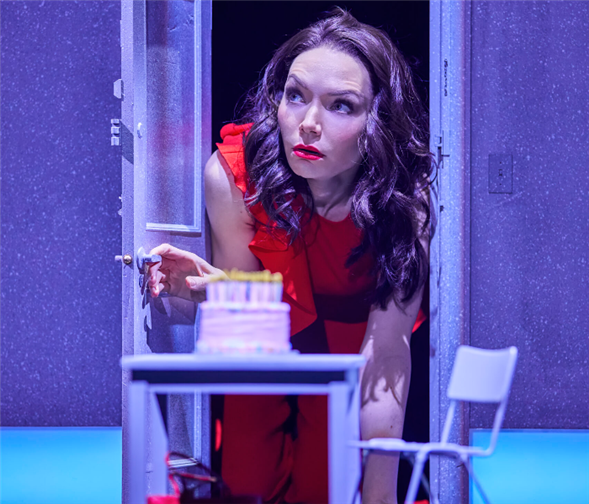
A slightly rearranged revival gave me a new appreciation of one of my favorite musicals
—
Something was different about this revival of Company.
With the revival of any musical, there are always differences: scenery, costumes, lighting, character interpretation, orchestration, keys. Changes in text often occur as well—authors’ prerogatives and/or reconsideration of societal values.
But director Marianne Elliott’s new take on Company went well beyond the expected, all with Stephen Sondheim‘s approval and participation. Genders were switched for five roles—most significantly, the enigmatic central figure Bobby, renamed Bobbie—along with changes in the concomitant pronouns in the text. (Of course, as a gay man, I’ve long been accustomed to changing pronouns as necessary.)
Knowing this in advance, I was eager to see how the new production would contribute to my experience of this seminal work of musical theatre, part of my life since I first encountered the original Broadway production on my 16th birthday, and revisited every time a new mounting played in New York (and, in one instance, Washington, DC).
I saw that initial production four times in total—to absorb, to learn, to feed on this masterpiece about relationships. I learned, among other things, how cast replacements can affect a show. For example, when Jane Russell succeeded Elaine Stritch as Joanne, the lyric “And, Jesus Christ, is it fun!” in “The Little Things You Do Together” had to be changed to “And my, oh my, is it fun!” because Ms. Russell would not take the Lord’s name in vain. Also, with each successive performance and cast replacement, “Getting Married Today” got progressively slower. (Marian Hailey’s distinctive voice did add a new level of apprehension to Amy.) In my limited experience, the only married couple with whom I could compare the ones on stage were my parents, and I did not see them up there.
The first major New York revival of Company was presented in 1995 by Roundabout Theatre Company. The strong cast was led by Boyd Gaines, who brought more humanity to Bobby. Debra Monk nailed Joanne’s personality and songs, and Veanne Cox did the same for Amy’s motormouth anxiety. Jane Krakowski was an adorable April en route to “Barcelona,” and LaChanze hit “Another Hundred People” out of the park. I had been with my partner Richard for nine years at that point, yet neither of us saw ourselves on stage that night.
When the Kennedy Center staged Company in 2002, I decided to bring my father, whose cardiac incident more than 30 years earlier nearly derailed my first exposure to the work. In 2002, he had been a widower for 11 years, after having been married to my mother for five decades. He did not share his feelings with me post-performance, beyond saying he enjoyed it. John Barrowman as Bobby and Lynn Redgrave as Joanne headed a cast that also included Side Show costars Alice Ripley and Emily Skinner. I was newly separated from Richard then and related even less to those married couples, though perhaps a bit more to Bobby.
John Doyle’s Broadway revival in 2006 was the second of two Sondheim shows he directed where the cast was also the orchestra. Tellingly, Bobby—memorably embodied by an intense Raúl Esparza—went through most of the production as the only performer who did not play an instrument, until he sat down at the piano near the end to tap out the opening notes of “Being Alive,” a powerful metaphor for his readiness to be part of something larger than himself. Barbara Walsh was a worthy addition to the list of Joannes I have known. Future phenomenon Elizabeth Stanley, in her Broadway debut, played April, as well as oboe, tuba and alto sax. I’ve played piano most of my life, but in the lexicon of this production, I was still singing a cappella.
A New York Philharmonic concert performance in 2011 came at an interesting time in my life. I had come through a brush with cancer, and many preconceptions about how I should exist in the world had been upended. Neil Patrick Harris was Bobby and Patti LuPone was Joanne—a lady who lunched long before her current Broadway engagement in the role. A veritable theatre who’s who (Jim Walton, Katie Finneran, Aaron Lazar, Martha Plimpton, Craig Bierko, Jennifer Laura Thompson, Jon Cryer, Anika Noni Rose and, with a surprisingly good singing voice, Stephen Colbert) joined a full symphony orchestra for a truly unique event. I was still single, but in a far different state of mind; this journey through the score left me unaccountably hopeful.
Sitting in the Bernard B. Jacobs Theatre for the current revival, I wondered how the gender realignments, as well as the other directorial and design touches, would affect me. As soon as the opening number revved up, I was 16 again, the excitement of its path-breaking brilliance suffusing me as it had then… until a moment shortly before Katrina Lenk as Bobbie started the first chorus, preceded by a modulation in the orchestra as subtle as a sledgehammer. I had a physical reaction to this key change equivalent to whiplash. Blame it on hours—years!—of listening to the original Broadway cast album, imprinted on my musical memory as indelibly as a Beethoven symphony. More than gender changes, this told me I wasn’t in Kansas anymore, and that I had better set aside my expectations. Thankfully, there were no more dislocations as jarring as that, even as shifted pronouns and unaccustomed vocal ranges redefined moment after moment.
Much still struck me as familiar, however, until the point in Act I after Sarah and Harry’s karate face-off and “The Little Things You Do Together.” Bobbie catches Harry alone and asks, “Are you ever sorry you got married?” As the opening notes of “Sorry-Grateful” sounded, I suddenly discovered the biggest change of all—and it wasn’t in the script.
This time I was married.
Each line of the song landed like one of Joanne’s brilliant zingers:
“You’re always sorry, you’re always grateful.” Check.
“Good things get better; bad get worse. Wait, I think I meant that in reverse.” Check.
“You always are what you always were, which has nothing to do with, all to do with her.” Change pronoun and check.
The prism through which I viewed Company shifted radically at that moment. The rest of the performance revealed insights heretofore hidden from me through half a century of watching and listening. (My husband, Ray, found common ground with Jamie—formerly Amy—and his prenuptial jitters.) But there was one more zinger in store, one I might have missed had it been Bobby instead of Bobbie.
After the nightclub scene with Joanne and Larry, a reprise of the title song begins, but Bobbie halts it and blurts out, “What do you get?” Then, she hesitatingly starts to sing “Being Alive.” The first verse is punctuated by encouragements from her married friends to take the next step in her thought process. And then Jamie uttered the words that galvanized me: “Blow out the candles and make a wish. Want something. Want something.”
In my generation, boys were typically socialized to be decisive, to go after what they wanted; girls were taught to acquiesce, to regard their needs and desires as secondary. The fact that Bobby in the original 1970 production didn’t behave so decisively may have had something to do with the theory that he might be gay. But for Bobbie, even in 2022, some of that outdated mindset seemed still to be in play. Could it be that, during “Being Alive,” she was overcoming the conditioning that she didn’t deserve to get what she wanted? As a gay man, even long after I had accepted my sexuality, I always felt that somehow, I didn’t deserve to be happy. And here I was, well on the other side of that destructive belief, suddenly identifying with the female protagonist of Company in a way I had never done when he was male.
As I left the theatre that day, I flashed back to another line from “Sorry-Grateful:” “Everything’s different, nothing’s changed; only, maybe, slightly rearranged.” This revival showed me that now I’m one of those “crazy married people,” and I can never see Company the same way again, kiddo.
—
Daniel Guss is a native New Yorker. During his career at RCA, he reissued over 1,000 compact discs, ranging from the recordings of such classical superstars as Arturo Toscanini, Jascha Heifetz, Arthur Rubinstein, Enrico Caruso, Sergei Rachmaninoff, Leontyne Price and James Galway, to classical music compilations and Broadway cast albums. He is now general manager of the Early Music Foundation.
Top image: Katrina Lenk as Bobbie in Company on Broadway. Photo by Brinkhoff-Moegenburg.
TDF Members: Go here to browse our latest discounts for theatre, dance and concerts.