
Paul Hilton Can Hear You Crying and That’s Okay

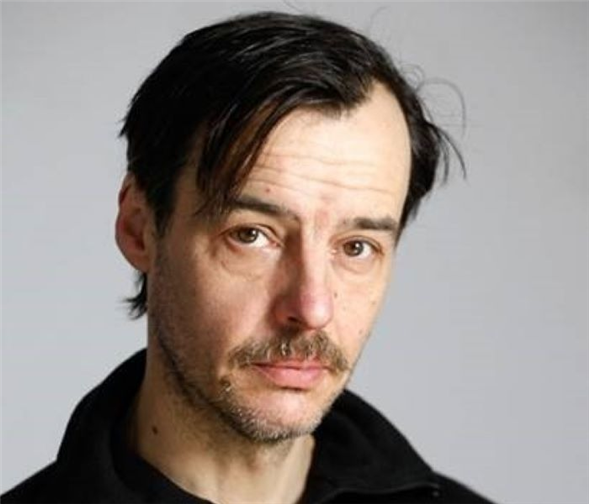
The veteran British actor talks about making his Broadway debut in The Inheritance
—
Paul Hilton always hears weeping when his character, Walter Poole, tries to explain to his younger friend Eric Glass (Kyle Soller) what it was like living through the AIDS crisis in the ’80s. The heartbreaking monologue closes out Act I of The Inheritance, Matthew Lopez’s two-part, seven-hour epic, a radical riff on E. M. Forster’s 1910 novel Howards End about the intertwined lives of three generations of gay men looking for community and connection in modern-day New York.
“It’s all been frivolous up until that point, then suddenly the specter of disease is summoned in that speech, and the tone and the whole atmosphere shifts,” says Hilton, 49, a stalwart of the London stage who’s making his Broadway debut. “Part of the magic of this piece is the way it affects people so profoundly. There’s audible sniffling and sobs. Every single time I play that monologue, I’m aware of the audience reacting very deeply to the conjuration of these ghosts. They fuel the emotional weight of the play. There have been performances where I’m literally fighting to hold back my own expression of emotion and that’s a very rare thing to achieve — particularly given that we’ve done this play well over 100 times and it still loses none of its impact. That’s really extraordinary.”
A smash in London where it won four 2019 Olivier Awards, including Best New Play and Best Director for Stephen Daldry, The Inheritance has transferred to Broadway for a limited run, and Hilton is reprising his role. Make that roles: He also plays Morgan, aka the gay novelist E. M. Forster, who travels across time and space to help a group of young queer men tell their multigenerational story filled with sex, art, politics, pain, death and, above all, love. Soller, whose empathetic Eric is the heart of the piece; Andrew Burnap as Toby Darling, Eric’s self-involved fiancé; John Benjamin Hickey as billionaire Henry Wilcox, Walter’s longtime companion; and Samuel H. Levine as aspiring actor Adam and street hustler Leo are also recreating their West End performances.
You don’t need to have read Howards End (or seen the Merchant Ivory film) to follow The Inheritance. The various threads of the saga unwind lucidly and (more or less) chronologically. Yet there’s a striking fluidity to its storytelling, as characters narrate parts directly to the audience, and even editorialize on what’s happening. “It’s a complex one,” admits Hilton, who has photos of Forster adorning his dressing room mirror. “I’ve never done anything quite like it. To be able to go from a scene that’s played out on the stage between two characters, to commenting on that scene is a very unusual conceit within theatre writing. It’s thrilling to play. I supposed that Morgan becomes a prism through which you see these young men. As with any writer, all of the characters that exist within his creation are aspects of himself, so you get that with Morgan. Toby, Adam, Eric — they’re all parts of him.”
Best recognized stateside for his turn in A Very English Scandal on Amazon Prime, Hilton says the night before his audition, he read the Inheritance script by candlelight in one sitting. “I was peeling myself off the floor — I was totally transported,” he recalls. “It was unlike anything I’d ever read. I lost my mum about four years ago, so it came right on the back of a lot of grief. It was very raw and truthful, and it sang to me. It came off the page in a way that most new plays don’t.” Yet while it’s prudent to bring tissues, The Inheritance isn’t all tears all the time. At various points it’s boisterous, bawdy, hilarious and, ultimately, life-affirming.
Hilton was raised in a working-class town in Northern England, and likens his upbringing to the character of Toby Darling, an up-and-coming writer who struggled as an adolescent. “Rather like Toby in the play, I was a young person who was deeply passionate about storytelling, which was probably born of a diet of American movies and the kids from Fame,” says Hilton. “I felt very much like a fish out of water. There was one teacher at the school who encouraged young people with an interest in drama to really pursue that. If not for him and his passion and his selflessness, then I might not be doing what I’m doing today.”
Coming of age in the ’80s, Hilton vividly remembers the fear surrounding AIDS. “In Britain, we had a big television awareness campaign with John Hurt, the famous actor, basically saying, ‘AIDS is a death sentence,'” he says. “It was terrifying. I was a teen and I was at my most exploratory stage in my life. I think any inclination that I may have had toward loving men was ground back into the closet. It had a profound effect on me in my formative years. My kids are 16 and 20 and it’s hard to explain to them and other young people today how the attitudes toward homosexuality were back then.”
That’s part of why Hilton’s been gratified to see audiences of all ages (well, 16 and up — there’s a fair amount of nudity and mature subject matter) at the show. The Inheritance is about history, legacy, and what we owe to the ones who came before us and those who will come after. “The diversity of people that I’ve met who’ve responded to this play are of all generations, all creeds, and that is just such a rare thing in theatre,” Hilton says. “I would go as far as to say I’ve never experienced anything like it, to consistently affect audiences in the way that we have. It isn’t just in the words and it isn’t just in the storytelling or the performances; it’s something bigger. We find ourselves talking about it quite a lot in the company: What is that thing that seems to break down everybody’s defenses? People who’ve never even met, by the end of seven hours, they’re holding each other and exchanging numbers. What is that? It could only be a sense of compassion and empathy and connection. It’s a beautiful thing.”
—
Raven Snook is the Editor of TDF Stages. Follow her at @RavenSnook. Follow TDF at @TDFNYC.
Top image: Paul Hilton.
TDF MEMBERS: Go here to browse our latest discounts for dance, theatre and concerts.