
Patrick J. Adams’ 25-Year Journey to Broadway

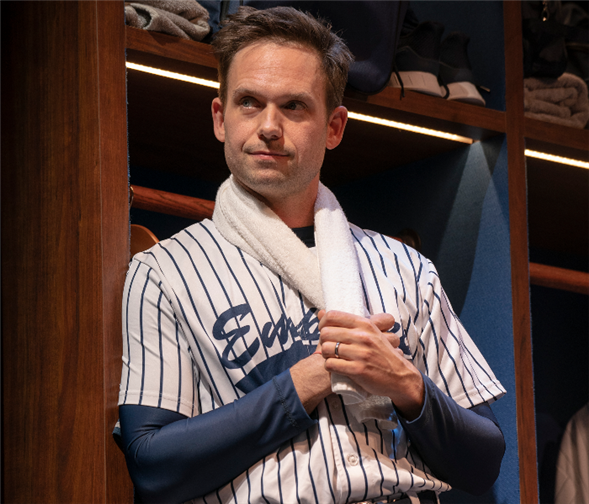
The Suits star talks about baring it all on stage, emotionally and otherwise, in Take Me Out
—
Patrick J. Adams has wanted to perform on Broadway since he was 15 years old. A quarter century later, he’s finally hit a home run as one of the leads in Take Me Out, Second Stage Theater’s revival of Richard Greenberg’s 2003 Tony-winning play about what happens when a beloved biracial Major League Baseball player comes out of the closet. Born in Canada, Adams is best known for playing a college dropout posing as a lawyer in the long-running USA series Suits. But while TV made him famous, theatre is what set him on the path to acting.
“I was going to theatre camp in Toronto, and we took a field trip to New York City,” he recalls. “Ever since then, I have always been in love with New York and with Broadway; I thought, this is the dream.” When applying to college, his top choice was the acting program at NYU. When he wasn’t accepted, he opted for the USC School of Dramatic Arts in Los Angeles. After graduating he stayed, building his professional and personal life (his wife is Pretty Little Liars star Troian Bellisario) on the West Coast. But his Broadway ambitions never subsided. Now, after a two-year pandemic delay, he’s finally making his Broadway debut alongside fellow TV stars Jesse Williams (Grey’s Anatomy) and stage vet Jesse Tyler Ferguson (Modern Family, The 25th Annual Putnam County Spelling Bee ). Adams chatted with TDF Stages about the challenges of always speaking one’s truth, overcoming stage fright and, yes, that famous full-frontal shower scene.
Gerard Raymond: After two decades of working in Hollywood, did you worry Broadway might never happen?
Patrick J. Adams: I wouldn’t say that the dream ever died, but at some point, I began to think it maybe wasn’t in the cards. I auditioned for things in New York but, honestly, no one ever seemed to bite. I kind of got the impression that I had missed the boat—I just wasn’t part of the New York community. Then, lo and behold, I was doing The Right Stuff TV series on Disney+ and I got a phone call saying that director Scott Ellis was interested in me for Take Me Out. I hadn’t read or seen the play; all I knew was that it was about a baseball player who comes out of the closet and that there’s a scene with a lot of nudity. That was scary. I’m not someone who really gets off on being naked in front of a bunch of people. In my mind I thought, I don’t think so, but I decided to read the play before I said no. Immediately upon reading it, I just knew I had to do it. The play is so beautifully written, and the nudity is a really important part of telling the story.
Raymond: Take Me Out was originally scheduled to open in spring 2020. What did it feel like when your long-deferred Broadway dream had to be delayed again?
Adams: You know, everything happens for a reason. I believe that. Not that the reason the world had to deal with a deadly pandemic was because I might not have been ready to do a play! [Laughs.] I remember we were in rehearsals about two weeks away from our first preview. The show was in good shape, but I was really nervous. I had struggled with some stage fright in a previous production, and I don’t think I’d done all the work I needed to figure out how to conquer that. So, I was a little worried that I was about to do a repeat performance of my stage fright. Then the world shut down. We didn’t know how long it was going to be, but I thought, right from the beginning, this is my chance. Whatever I wasn’t ready to do, I had some time to get right. I spent a lot more time with the script and a lot of time talking to professionals about stage fright and anxiety. I really focused all that extra time that the world gave me on making sure that, whenever we got back into the rehearsal room, I would walk in feeling as prepared as humanly possible. It was a real gift to come back two years later with a completely fresh perspective. I’ve never spent so much time with a piece of material. It is something I learned a lot from. I hope to be able to bring that level of preparation into things that I do from now on.
Raymond: Your character, Kippy, is the anchor of the play, filling in parts of the story with direct-address monologues. What’s that like?
Adams: I play a baseball player who is best friends with Darren (Jesse Williams), my famous teammate who comes out. I’m also the narrator. I have a fair amount of material in which I’m taking the audience through the events as they unfolded. As the story goes on, you realize that Kippy also played a pretty pivotal role in the series of events. So, I have the unique and fun opportunity of jumping back and forth, being with the audience and telling them the story as well as participating in the story. I don’t want to ruin the play for anybody, but the stakes get higher and higher, especially in Act II. The play deals with identity and masculinity and toxicity and the struggles of being honest with each other. I think that is the core question of the play: Are we all supposed to speak our whole truth all the time to everyone? Initially, Kippy believes that. I think he quickly learns that might not be such a good idea.
Raymond: The play’s other main character is Darren’s gay accountant Mason Marzac [Jesse Tyler Ferguson], who becomes smitten with baseball when his client comes out. Are you a fan of America’s pastime?
Adams: You know, I must speak my truth as Kippy would want me to: No, I’m not a fan of baseball. I didn’t grow up in a house where we watched a lot of sports. I tried to play sports at school, but I was not a natural athlete, and I didn’t get along with the kids who played sports. As an older person, if I’m watching sports with people who know what’s going on, I love it because they explain it to me. I’m always curious about things I don’t know about. We were at Yankee Stadium the other day and it was phenomenal. But it wasn’t the same for me as it was for a lot of the other guys in the play who grew up watching these games. It was a holy piece of land for them. But getting to be there, seeing it through their eyes and having them explain to me why this was so important, it enriched my understanding of baseball and what we are doing in the play. It’s about using this legendary, timeless, American pastime as a canvas for a very human story, which could ultimately take place in any high-stakes environment where a lot of people need to work together to accomplish a goal. I am more interested in the power differential between the best player on the field versus the brand-new catcher who just showed up, and the friendship between Kippy and Darren. All those human interactions and relationships, that’s what fascinates me.
Raymond: You made your professional stage debut in a production of Edward Albee’s The Goat, or Who is Sylvia? at LA’s Mark Taper Forum in 2005. That’s a very demanding play from a writer, who, like Greenberg, is particular about language. What was that experience like?
Adams: My memories of doing The Goat are about just holding on for dear life. I felt it was pretty much an extension of my education. I remember doing everything I could to watch my castmates: the amazing Cynthia Mace and Brian Kerwin. They had already done the play before, and they knew how to use the words. I had only done theatre in school with other students and, all of a sudden, I had a front-row seat to real theatre actors who were figuring out how to wrestle this big idea play. To this day, Cynthia and Brian are dear friends. That whole experience was a master class for me in learning how to use the language of great playwrights.
Raymond: You mentioned that you initially had concerns about the nudity in Take Me Out, but you previously appeared naked on stage in 9 Circles at Bootleg Theater in LA. How has your attitude about on-stage nudity evolved?
Adams: 9 Circles was a play that I produced and the nudity was very contained—only people sitting at a certain angle could really see it. It was pretty quick, but it was scary and I felt very vulnerable. This is totally different and more daunting: It’s a scene with six guys in a row in a shower. The stage is well lit, you are not hiding behind anything. But as soon as I read the scene, I thought, this is just beautifully written. It is obvious they have to be naked. He is highlighting the fact that they were so free before—the guys being naked and patting each other on the butt and nobody cared—and how that changed. That’s the tragedy. Darren just told the truth of who he was, and suddenly they couldn’t think straight. It’s not nudity just for nudity’s sake. But don’t get me wrong, it’s still scary. Every night when I am about to take my towel off, I think, what am I doing? But I quickly readjust—I’ve got a job to do. I think Scott has staged it beautifully and, thankfully, the audience goes with us. My fear was that the minute we came out on stage, there would be so many snickers and people laughing and giggling that they wouldn’t hear the words. For me, that would be heartbreaking. Every single performance so far people have been respectful. You can hear maybe a little shuffling at the beginning, but as soon as we start talking, people are listening. That’s all that matters.
Raymond: I’m sure you appreciate that audiences are required to check their cell phones into locked Yondr bags so they can’t sneak photos or video.
Adams: I think those Yondr bags are amazing, and not just because they keep us from being filmed. Not having their phones, people talk to each other. When we go for intermission, people turn to each other and have a conversation about what they just saw, you know, the way it used to be. I think those bags are incredible and they make the night even better because they put people really in the room and focus them. We are there together in the room, which, after the pandemic, is a gift that none of us should turn away from.
This interview has been lightly edited for length and clarity.
—
TDF MEMBERS: At press time, discount tickets were available for Take Me Out. Go here to browse our current offers.
Gerard Raymond is an arts journalist based in New York City who’s a member of the Drama Desk and the American Theatre Critics Association.
Patrick J. Adams in Second Stage Theater’s production of Take Me Out on Broadway. Photo by Joan Marcus.