
My Unfair Lady: Why Are Smart Women in Musicals Treated So Poorly By Men?
As an intelligent, ambitious woman who loves theatre, I wish I had better musical role models
—
While watching a friend’s cabaret show, I had a depressing epiphany. In between songs, she and her male collaborator engaged in playful banter that highlighted their camaraderie and mutual admiration. Then, they would sing another show tune that reeked of inequality. The stark difference between their interactions as colleagues as opposed to characters made me realize how rarely smart, ambitious women in Broadway musicals are valued for their brains by the men in their lives.
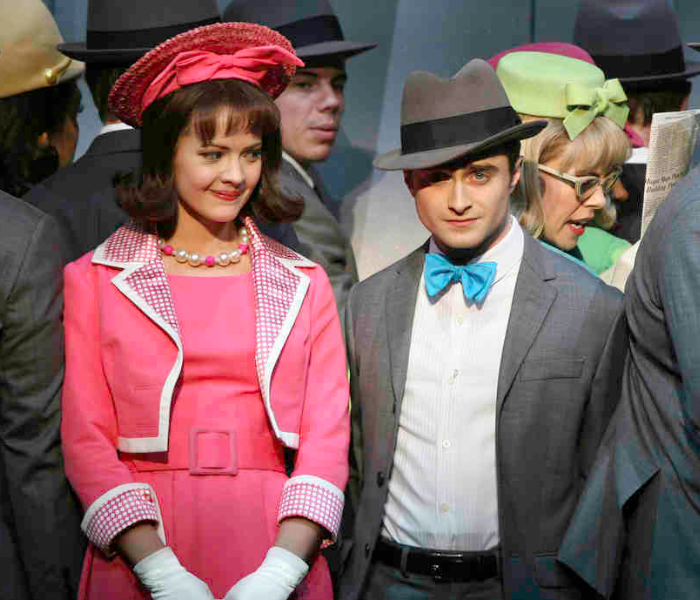
While a few recent musicals like Kinky Boots and Waitress (both cowritten by women) have at least one male character who champions a woman in his workplace, it’s far from the norm. In most musicals set at work (see How to Succeed in Business Without Really Trying, Promises, Promises and 9 to 5), the men are sexist and obnoxious if not downright villainous, objectifying their female coworkers, undermining them and taking credit for their work. Granted, many of these scenes are played for laughs, but any woman who’s ever been harassed or dismissed at work knows they really aren’t that funny.
In classic Broadway musicals, working women are often presented as victims of circumstance. Julie Jordan in Carousel and Magnolia Hawks in Show Boat need to work because they married “bad” men incapable of supporting them. Hello, Dolly!‘s Dolly Gallagher Levi and Irene Molloy are widows. South Pacific‘s Nellie Forbush is a nurse, providing support for the war effort. Generally, their jobs are stereotypical “women’s work,” like matchmaking (the title character in Hello, Dolly!), baking (Jenna in Waitress) or serving as a nanny for two (the title character in Mary Poppins) or many more (Maria Rainer in The Sound of Music). Sometimes, these women are only working until they can find a man to marry and move to the burbs. It always seems to be Westchester: Guys and Dolls‘ Sarah Brown is dreaming of a “Scarsdale Galahad” in a Brooks Brothers suit while How to Succeed…‘s Rosemary Pilkington can’t wait to keep dinner warm for her “darling tycoon” in New Rochelle.
Working women can also be presented as villains (Eva Peron in Evita) or comic relief (Hildy Esterhazy in On the Town) or both (Mrs. Lovett in Sweeney Todd, Mayoress Cora Hoover Hooper in Anyone Can Whistle), which arguably dehumanizes them. At the very least, it prevents the audience from taking them too seriously.
If a woman is passionate about her career, it’s often used as a romantic obstacle, either because she’s more successful than her man (Fanny Brice in Funny Girl) or is seen as an ice queen in need of melting (Marian Paroo in The Music Man, Rosalie in School of Rock). Sometimes, a guy learns how to love his lady despite her career (Pajama Game, She Loves Me), but often the men around a talented, ambitious woman will betray her, particularly in shows set in the music industry like Dream Girls. (KPOP is an interesting exception to the rule: MwE’s boyfriend supports her as she tries to find her own voice.)
Even more disturbing is when an older male character grooms a younger, susceptible woman (Christine Daaé in The Phantom of the Opera) for his (or other men’s) pleasure. Unfortunately, non-white women are frequently cast as oversexualized victims, like Kim in Miss Saigon.
On occasion, musicals have a fatherly character who provides helpful guidance to the female protagonist, but it’s usually romantic advice. In Finian’s Rainbow, the title character tells his daughter Sharon to “follow the fellow who follows a dream.” I know he was a product of his time, but so am I. Why doesn’t he just tell her to follow her own dream?
These sobering examples make me wonder why musical theatre—one of America’s few indigenous art forms—seems so out of touch. For well over a decade, TV shows like 30 Rock and Parks and Recreation have featured male bosses who platonically mentor smart, ambitious female colleagues. Where are the Jack Donaghys and Ron Swansons of Broadway musicals? In the years since those two characters debuted on the small screen, Broadway has seen revivals of Carousel, Guys and Dolls, How to Succeed…, Promises, Promises and many other Golden Age shows with troubling gender dynamics. Perhaps these revivals are supposed to make us think about how much we’ve evolved since they were written, but instead they expose how far we haven’t come.
Upon winning her first Tony Award for best original score for Fun Home in 2015, Jeanine Tesori famously said, “For girls, you have to see it to be it.”
As a musical lover, I would have benefitted from seeing more men supporting smart, ambitious women, especially because I was getting mixed messages at home. My boomer parents were both raised in very patriarchal households. Old habits die hard and, despite their best efforts and mine, all was not egalitarian.
As an adult, it’s taken me nearly a decade to get to a point where I am fortunate to work with male colleagues who treat me as an equal. At one of my first jobs in the theatre industry, a well-meaning woman in my office recommended that I wear makeup when speaking to my older male bosses because she’d noticed that they tended to respond better and take her more seriously when she was done up.
The lack of support isn’t just in the workplace. My female friends and I frequently discuss the challenges of heterosexual dating when we’ve got more credentials, a higher salary or more ambition than our male partners. I know an accomplished woman whose ex-boyfriend couldn’t get past the fact that she had two graduate degrees while he had a bachelor’s. The married women I know with full-time, high-paying jobs still inevitably do more of the housework and childcare than their male spouses. It continues to send the upsetting message that a woman’s career is less important than a man’s. I can only imagine how much worse it is for transwomen and nonbinary folks. Perhaps musicals are reflecting our uncomfortable, inequitable reality.
And that must change. When I think about the future—especially the future of musical theatre—I am hopeful. More women are writing mainstream musicals and receiving recognition for their work. The first woman to receive a Tony Award for best original score without a male writing partner was Cyndi Lauper, and that was just 10 years ago in 2013. Since then, Mean Girls and Kimberly Akimbo (both cowritten women) have featured teenage boys appreciating teenage girls for their intelligence.
As more millennials and Gen Zers pen Broadway musicals, I am optimistic that we’ll see shows in which smart, ambitious women are treated with the respect, admiration and encouragement they deserve. To quote Merrily We Roll Along, one of the few 20th-century musicals with a brilliant woman whose male friends recognize her worth, “It’s our time.” In fact, it’s long overdue.
Top image: Rose Hemingway and Daniel Radcliffe in How to Succeed in Business Without Really Trying on Broadway. Photo by Ari Mintz.