
Making More Space for Latinx Artists
The Sol Project returns with a new production
—
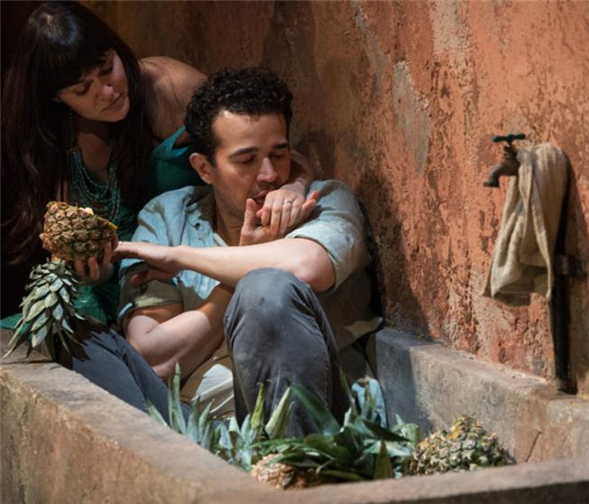
A traumatized doctor named Moisés sits in a washtub filled with pineapples that he repeatedly crushes open and bites into. A badly wounded character whimpers in pain, unattended, in an upstage courtyard while paralyzed townspeople listen. A soldier drags another character away to be beaten.
These moments are frequently terrorizing, occasionally perplexing, and utterly believable. They are all part of Martin Zimmerman’s Seven Spots on the Sun, which features portrayals of intimate violence and politicized terror in a fictional South American town.
The show runs through June 4 at Rattlestick Playwrights Theater, which is co-producing it with the Sol Project initiative. If you don’t already, then get to know the Sol Project’s name, because they’ll be responsible for many more plays as compelling and urgent as this one.
The community built since May 2016 around the Sol Project in general, and this production in particular, has been developed with passion, hope, and an inspiring mission to build a larger Latinx theatre presence in New York City and around the United States. The Project provides playwrights with both a foothold in the Off-Broadway scene and connections to the theatres throughout the country.
In 2013, when the Sol Project’s founding artistic director Jacob G. Padrón was a producer at Steppenwolf in Chicago and had just been appointed a producer at the Public Theater in New York, he attended the Latino/a Theatre Commons at Emerson College. “We really tried to critically assess the state of Latino theatre relative to the larger ecology,” he recalls.
Conference attendees noted the influence of a New York City production on a play and a playwright. Valuable work by Latinx artists was being developed all over, they said, but the New York imprimatur was still necessary to open important professional doors.
When Padrón landed in New York, then, he was mindful of its influence. He convened a daylong discussion at the Public to assess the Sol Project’s viability. “How do we create a robust pipeline to production, partner with our leading Off-Broadway companies, create a body of work that we can contribute to the American theatre?” he says, remembering that conversation. “How do we hold the American theatre accountable so that it is a repository of ALL of our stories? How can our Latino writers and storytellers be in conversation with the writers that are produced in mainstream theatre? The animating idea is to create a national movement by creating this body of work and giving opportunity to Latino voices.”
In planning his new project, Padrón drew from other successful theatrical initiatives. “I took a page from 13P, the collective where 13 writers self-organized, galvanized, and self-produced,” he says. “I thought: why don’t we do [a group of] 12 and pair each playwright with a leading Off-Broadway company who will commit to producing their plays?” He also drew from the National New Play Network‘s commitment to “rolling world premieres,” meaning that multiple theatre companies agree to produce a new play in the same season. “Once the play has happened in New York, let’s enlist regional partners all around the country who can commit to the continued life of the play,” Padrón says.
Padrón’s six-member Sol Project artistic collective acts as a mini theatre company to drive the initiative and support play selection. Collective member Elena Araoz connected the Project to Susan Bernfield at New Georges, who quickly co-produced the project’s first play, Alligator, which opened in December 2016. Padrón describes Bernfield, who championed the project before there was money in hand, as a producer of action.
The Sol Project, however, is not just about individual productions. It’s about organizational transformation. Padrón insists his collaborators make inclusive programming a core practice, and when they sign on, they commit to inclusivity and equity in staffing and board composition. Each partnering company also agrees to mount a particular play that they help select, to commission an additional Latinx writer, and to meet with as many artists of color as they can before hiring teams. It’s about creating a pipeline for diverse talent.
When Daniella Topol, Rattlestick’s artistic director, approached Padrón, she had already committed to produce Seven Spots on the Sun, and she proposed a Sol Project partnership. Together, they pushed themselves to fill the creative team with people of color, including an Ethiopian-Canadian female director, Weyni Mengesha.
Zimmerman, who is bilingual and identifies as multiethnic, is especially happy to be working with this team. “What’s admirable about the Sol Project is it’s saying, ‘We’re not going to wait for certain people to bless what we’re doing,'” he says. “‘We’re going to create a canon and make sure that our work is being disseminated across the country.'”
To that end, Padrón believes that the Sol Project can be transformational. “The hope is that after all 12 writers have been produced, we won’t be needed,” he says. “There will have been the transformation in our partner companies, and they will then continue to hold up the values and the mission inside their own organizations.”
—
Follow Martha Wade Steketee at @Msteketee. Follow TDF at @TDFNYC.
TDF Members: At press time, discount tickets were available for ‘Seven Spots on the Sun.’ Go here to browse our current offers.
Top photo by Russ Rowland, featuring Flora Diez and Rey Lucas in ‘Seven Spots on the Sun’