
Low Vision Can’t Stop This Stage Diva
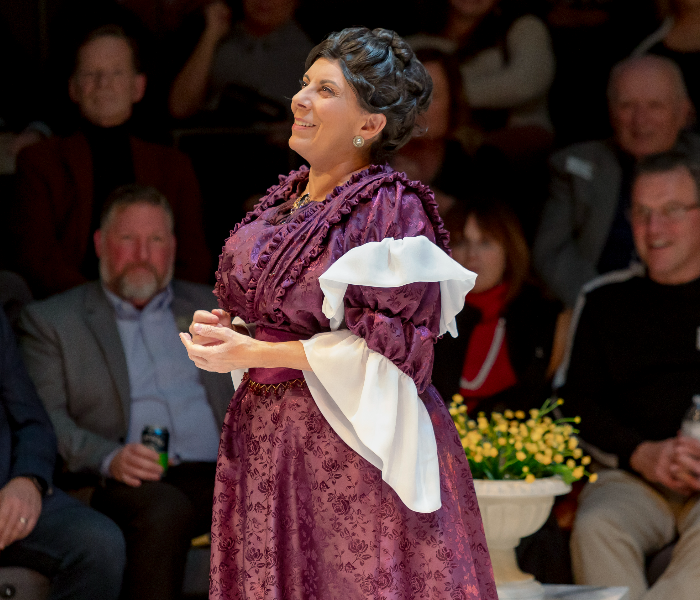
Christine Pedi talks about starring in a new Off-Broadway comedy while living with AMD
—
Christine Pedi insists she “manifested” her star turn as Lady Bracknell in The Rewards of Being Frank, Alice Scovell’s witty sequel to Oscar Wilde’s The Importance of Being Earnest. A beloved NYC performer best known for her hilarious, spot-on impressions of Broadway divas in myriad editions of the satirical revues Forbidden Broadway and NEWSical the Musical, Pedi says “there’s a robustness” to Lady Bracknell that reminds her of the musical theatre icons she’s known for channeling, like Liza Minnelli and Bernadette Peters.
Still, Pedi admits that playing the comically conservative Victorian social climber wasn’t always on her wish list. But since the onset of her AMD, age-related macular degeneration, which has caused blindness in one eye and low vision in the other, Pedi realized that doing musicals with vigorous choreography and large casts was too challenging. An intimate English drawing-room comedy, however, seemed doable.
“I can walk in and sit on a settee, say wee English things, get up and leave,” Pedi says, adding that in recent years she joked about playing Lady Bracknell. So, when she was asked to send in an audition tape for that very role, Pedi felt like it was fate. “I guess I did that.”
Co-produced by Cincinnati Shakespeare Center (where it premiered earlier this year) and New York Classical Theatre, The Rewards of Being Frank is currently running at Off-Broadway’s A.R.T./New York Theatres through March 26. It picks up seven years after Earnest, with Lady Bracknell overseeing the selection of a tutor for her grandsons. Just as in Wilde’s original farce, a humorous series of misunderstandings and mistaken identities, quips and social critiques ensue. “We are not interested in the boys being prodigies and, thereby, becoming social outcasts,” Lady Bracknell declares. “We want them to have lots of informational breadth, but absolutely no depth.” Frank Teacher, a boldly honest third-rate tutor, fits the bill. According to Pedi, Scovell’s play “stretches and elbows and pushes the envelope, while still keeping within the clear style of Oscar Wilde.”
To ensure Pedi could perform the role comfortably and confidently with her disability, the producers made many adjustments. “There are a lot of nuts and bolts, hands-on physical and technical things that have been done that not only made my life easier, but have made it possible,” she says. Backstage accommodations include white gaffer tape outlining walkways and rope lights illuminating the wings. Pedi supplies her own lighting for her dressing room, and for emotional support, she brings her dog to the theatre. She is particularly grateful to Stephen Burdman, the director of the show and the founder of New York Classical Theatre. “He has been ultra-accommodating and helpful on every level, from practical amendments and emotionally, just being kind and supportive,” she says.
On stage, Pedi follows precise blocking to safely navigate around furniture since she does not have peripheral vision. She also follows her castmates’ voices to ensure her attention is aimed in the right direction. “As far as being a disabled person on the stage, if I had to, you know, go blind, this was the perfect time in history to do it,” Pedi says with a dry laugh, adding that she’s encouraged by how much inclusive casting she’s seeing these days. “A lot of places are embracing the opportunity to figure out how to make it work.”
As a theatregoer, Pedi is gratified that accessibility and inclusion efforts extend into the audience. She mentions TDF Accessibility Programs such as audio description and touch tours for low visibility patrons, though she was particularly impressed with what the theatre industry is doing in London. On a recent trip, Pedi attended Cabaret on the West End and was greeted by an accessibility manager who took her up to the mezzanine and met her at intermission. “That was just above and beyond,” she says. “It made me feel so much more relaxed and made it so much less of an obstacle course.”
Pedi acknowledges that, eventually, her disability may force her to retire from the theatre. So, she’s leaning into offstage projects, like her longtime hosting gig on SiriusXM’s On Broadway channel. She also hopes to book voiceovers and teach master classes, and maybe even help manifest a cure for AMD.
“I certainly hope and pray that the remarkable, incredible, superhuman strides made in stem cell and anti-aging research will, hopefully, at some point, apply to me,” Pedi says. “I don’t walk around like Pollyanna about it, but just sort of keep it in the ether, the way I kept playing Lady Bracknell in the ether. I don’t expect it, push it or clutch it. Every day I have to become more accepting of what I have today.” And today, she has a show to do.
—
TDF MEMBERS: At press time, discount tickets were available for The Rewards of Being Frank. A recording of the production is also available to stream at home. Go here to browse our latest discounts for dance, theatre and concerts.
Top image: Christine Pedi in The Rewards of Being Frank. Photo by Mikki Schaffner.