
It’s Your Job to Figure It Out

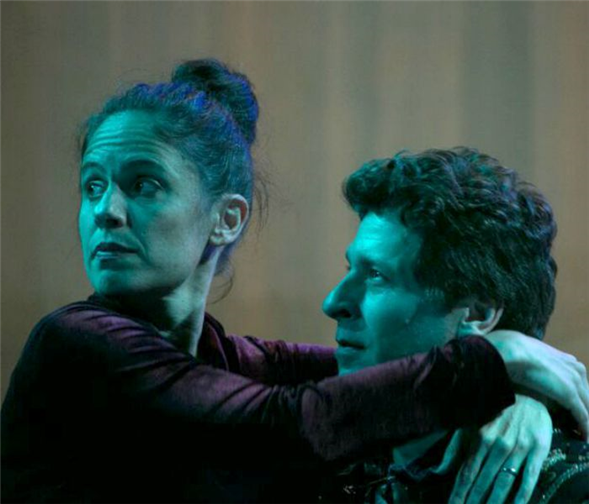
Why Richard Maxwell refuses to give audiences all — or any — answers
—
Richard Maxwell wants to make something clear: “I don’t want to be this niche thing.” It’s a strikingly direct statement from a groundbreaking experimental theatre auteur whose shows intentionally leave themselves open to myriad interpretations. The playwright/director doesn’t make the kind of theatre that is typically considered commercial, which is why he founded the New York City Players in 1999 to collaborate with likeminded artists including his wife, actress Tory Vazquez. However, after years of playing brief runs to dedicated fans who were already on board with his signature style — poetic language, absurdist humor, and intense emotions often delivered with a flat affect — he’s reaching a new demographic with Isolde at the Polonsky Shakespeare Center in Brooklyn.
Inspired in part by a dream Maxwell had as well as the centuries-old romantic tragedy of Tristan and Isolde, Isolde enjoyed a short but celebrated run at the Abrons Arts Center last year, and is now being remounted by Theatre for a New Audience with the same cast. Vazquez plays the title character, a married actress who’s losing her ability to remember lines and decides to distract herself by trying to build her dream house. However, the project may be her undoing.
The company is venturing outside its comfort zone with this production, performing for an audience that is largely unfamiliar with its work and style, and also playing a full slate of eight shows a week. “We’ve never done a standard eight-show week, and it’s definitely more exhausting,” Maxwell admits. “It will be interesting to see how that informs what the actors do. I was talking about this to a college friend of mine who’s in The Curious Incident of the Dog in the Night-Time on Broadway. It’s Wednesday and you have a great show, and then Thursday comes and it doesn’t matter. Congrats on the show last night — this audience doesn’t care. They’re here now. The history you have with the show is meaningless to an audience that’s seeing the play for the first time. As a performer, it really brings you into the present and heightens the value of the moment.”
To Maxwell, actors staying in the present is so paramount, he never demands that they summon up specific emotions or try to elicit certain reactions. “On the one hand, I ask actors to bring all of themselves, who they are as compassionate human beings, to each moment,” he explains. “But being beholden to feel something seems like an odd pressure to put on someone, and I’m not sure we need that as viewers. Audiences get so much information from just looking at live human beings, which is a unique opportunity that theatre provides, and we combine that with the words they’re saying. There’s this synthetic process that happens in our brains we’re usually not even aware of. I think it’s important to be mindful of how much the viewer can make out on their own.”
Maxwell is fond of saying that “the audience completes the equation,” but he doesn’t just mean in the “if a show plays to an empty house does it really exist?” sense. He believes viewers invariably impact the performance itself. “I think it’s true in all theatre but it’s more acute with this show,” he says. “It’s not a new play for us. We’ve done it before in different cities, but when we had our first preview that was a wake-up call. I felt like we had to hit reset to start performing again. Theatre is ephemeral. You can’t go back and play something again, as tempting as that might be. You are encouraging this immediacy and this connection between the actors and the audience, and it’s something you can’t fake. I try never to take that for granted.”
Although an unsettlingly realistic sex scene between Isolde and architect Massimo (Gary Wilmes), with whom she’s having an affair, is inevitably the most talked about moment in the show, Isolde’s seemingly throwaway line, “I’m going to check on the casserole” provokes one of the biggest laughs of the evening. After she leaves, Massimo asks her husband, “That’s a joke?” and he responds, “Not sure. What business is that of yours, sir?” It’s an absurd and insightful exchange that illustrates how meaning is determined by the listener — and that’s just the way Maxwell likes it. When I shared my theories about what I thought the show was about, he offered no confirmation or argument, just encouragement. “Impose away! It’s your job as an audience to impose. The conversation that can happen after one of my shows is more important to me than whether someone thinks the play was good or bad. I love to hear different audience members’ interpretations because ultimately, it doesn’t matter what mine is, and mine’s always changing anyway. There’s a temptation as a writer to explain things, but if everything was explained, would we return to theatre? I think not.”
—
Raven Snook is the associate editor of TDF Stages
Photos by Gerry Goodstein