
Is Sentimentality a Dirty Word in Dance?

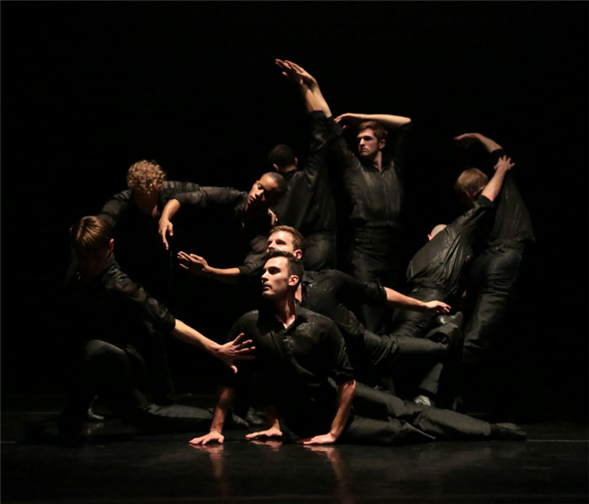
Lar Lubovitch celebrates 50 years as a choreographer at the Joyce
—
After a half century of running his own eponymous dance company, celebrated choreographer Lar Lubovitch is confident in his aesthetic preferences. “I defend my right to create beauty, even sentimentality, in a world where irony seems to be pervasive,” he says as his troupe kicks off its 50th anniversary with a a weeklong run at the Joyce (April 17-22). “Irony is fine in its place: It’s humorous and dark and it’s applicable in many instances. But if irony were all there was in the world, we’d be living in a very cold, dark place. My inclination is to create beauty, because beauty is the antidote to irony — just straightforward, honest feeling.”
Throughout his career, which includes choreographing for multiple ballet companies, Broadway musicals and even Olympic figure skaters, Lubovitch has forged a singular style that draws on his background in ballet and modern dance. That combination has resulted in an expansive and expressive full-bodied movement vocabulary that has survived and thrived in the constantly changing dance world. “I never leaned towards any trends, but I shifted and kept evolving along the way,” he says. “I went through different phrases of my own development, my own research about how to make a dance.”
Born in 1943, the Chicago native discovered dance at 19 while at the University of Iowa, and was advised to begin his studies at the American Dance Festival. “My very first class at 9am was taught by Martha Graham,” he recalls. “The next class I took was with Alvin Ailey, and then there was lunch, and my next class was with José Limón. And that was the first day of my life as a dancer! It was just good luck.”
Lubovitch soon made his way to New York City where he enrolled at Juilliard and started learning a wide range of styles. “When I arrived, there was a huge split: ballet and modern were really warring camps,” he says. “It was understood that you couldn’t do one if you were doing the other, that it would ruin you — philosophically, technically. But I was studying all forms: ballet, the classic modern techniques, ethnic dance, and I was working as a professional go-go dancer in a Greenwich Village club. To me, it was just all dancing. I didn’t see any of those things as exclusive languages.”
Lubovitch was dancing with Harkness Ballet when he launched his choreographic career with a single performance at the 92nd Street Y in 1968. “That first concert immediately opened the door to touring,” he recalls. “An agent appeared and wanted to send us on the road. It became a company suddenly without my having ever decided to make it one.”
His troupe thrived during the dance boom of the 1970s and ’80s, with regular New York seasons at City Center and steady touring. But eventually Lubovitch opted to change his working model. “I felt the form itself was trapping me,” he says. “My focus was dedicated to maintaining repertory in order to tour, and making a dance which had to fit in with the existing dances to balance a program. It was limiting my choices of why to make a dance, and what dance to make.”
So he became project oriented in order to create unencumbered by constant obligations. Most of the Joyce run comes from this period, including Men’s Stories: A Concerto in Ruin, a 48-minute work for nine male dancers which anchors all three programs. He created it in 2000 for performers he chose for their depth of experience and individuality, and its current cast includes a mix of Lubovitch veterans and neophytes.
One Lubovitch stalwart, Reed Luplau, is thrilled to return to the piece after dancing on Broadway in Fiddler on the Roof and Natasha, Pierre & the Great Comet of 1812. “I absolutely love dancing for him,” Luplau says. “He’s the sweetest man, so talented, and has a real voice.”
The Joyce lineup also includes Something About Night, a world premiere set to Schubert choral music, 2007’s Little Rhapsodies, plus guest appearances by Joffrey Ballet dancers (in several scenes from Lubovitch’s 1997 Othello) and the Martha Graham Dance Company performing 2010’s Legend of Ten. “Since my very first moment in dance was with Martha, I wanted her somehow represented as part of my history,” Lubovitch says. “So I asked the company to perform and chose this work for them.”
The oldest work represented is 1985’s A Brahms Symphony, which he says marked a watershed moment. “It opened me out to a whole other idea of what I was going to be as a choreographer,” he says. “That Brahms music in all its passion and drama and — excuse the dirty word! — sentimentality does express very much the heart of who I am as a creator.”
—
Susan Reiter regularly covers dance for TDF Stages.
Top image: Men’s Stories by Lar Lubovitch Dance Company. Photo by Steven Schreiber.
TDF Members: Go here to browse our latest discounts for dance, theatre and concerts.