
In Broadway’s ‘The Cherry Orchard,’ a Surprising Use of Dance
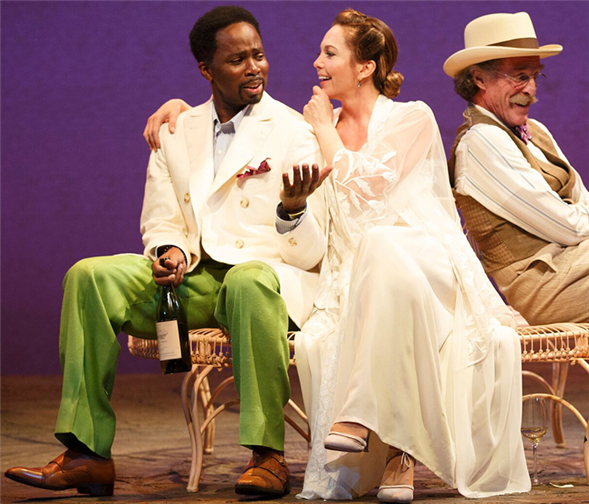
Making Chekhov a moving experience
—
There’s a scene in the Roundabout Theatre Company’s current Broadway revival of The Cherry Orchard where partygoers stream on and off the stage, making merry and celebrating the return of Madame Ranevskaya, a Russian landowner who has fallen on hard times.
But the celebration takes a dramatic turn when the news comes that her homestead and her beloved cherry orchard have been sold to Lopakhin, a local businessman whose family members have been servants on the property for generations.
The crowd goes quiet at the news, but Lopakhin, played by Harold Perrineau, insists that the party continue. He orders the musicians to start up again, and he begins to dance alone. Soon enough, his dance turns primal, expressing joy, pride, anger, grief, defiance, and finally a wild triumph.
For movement director Jonathan Goddard, who is working on this production with director (and frequent collaborator) Simon Godwin, this scene carries enormous weight. “I knew from the beginning Simon wanted to make it a really fresh and dynamic take on The Cherry Orchard,” he says. “In a play where there are so many incredible words, I felt it was really important that somebody can express a key moment – a moment that is so intrinsic to the play – without any words.”
Finding a fresh angle on the show might seem daunting. After all, Anton Chekhov’s play, which premiered at the Moscow Art Theatre in 1904, has long been considered a cornerstone of world drama. Its themes of dwindling purpose and economic upheaval – not to mention its aching lyricism and subtle symbolism – arguably created a template modern theatre.
This revival honors that past, but thanks to a new adaptation by Stephen Karam (also on Broadway with his play The Humans), it injects a modern energy into the language that Godwin and Goddard mirror as well. “I first read [Stephen’s] script and then watched a lot of earlier versions of the play,” Goddard says. “What I noticed was that often there were a lot of people sitting in chairs for ages just talking to each other. So I was quite excited Simon wanted to do something quite different.”
This includes commissioning original music from Nico Muhly. “His music is brilliant for movement and dance,” Goddard says. “Because we had three musicians quite early in the rehearsal process, we came up with [movement] possibilities, which they conveyed to Nico. It was quite an organic process.”
The three musicians also perform on stage during the third act party, which gives the scene more energy and propels the flow of the movement.
Traditionally, Goddard notes, the party is held in an off-stage room. We only hear the distant sounds of the festivities, while a stray reveler occasionally interrupts the tense, on-stage scene of Ranevskaya waiting for news about the estate’s sale.
“Simon felt it was important that the sense of the party would also happen on stage,” Goddard says. “But it was a massive challenge because you have loads of text. You can’t have partygoers going silent while people talk. So to get that feeling of anarchy took a lot of planning. But I think we achieved that sense of wildness, which is quite hard to do when you have to keep things clear.”
For Lopakhin’s big moment, it also helps that Perrineau has trained with Alvin Ailey American Dance Theater. “The party climaxes with Lopakhin’s moment, and so it really needs something special,” Goddard says. “Harold saw where the character could go in this moment of great internalization.
“It’s choreographed, but I didn’t want to look like it was. But it’s very structured – although he has freedom to be within the moment that he is feeling. We developed it together bit by bit, sort of like painting, just finding what the colors might be.”
The dance piece gets an additional sense of drama when one of the servants, Yasha, seems to be the only one who understands what Lopakhin is experiencing. Yasha cannot contain his own emotions, and for a brief moment joins in the dance only to abruptly remember his place and return to his silent duties.
These touches underscore the heart of the script. “I feel the more risks you take and the braver you are, the more Chekhov’s writing rewards you back,” Goddard says. “The play can really take it.”
—
TDF Members: At press time discount tickets were available to ‘The Cherry Orchard.’ Go here to browse our current offers.
Follow Frank Rizzo at @ShowRiz. Follow TDF at @TDFNYC.
Photos by Joan Marcus. Top photo (L to R): Harold Perrineau, Diane Lane, and John Glover