
How Yiddish ‘Fiddler’ Brought Me Closer to My Family
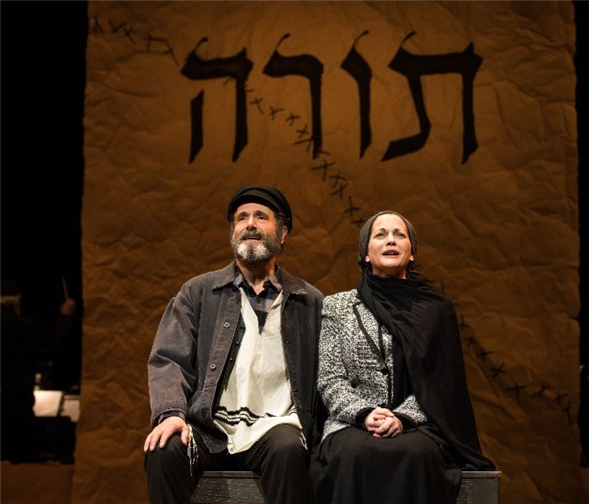
I was unprepared for how the current revival would affect me
—
From the moment I heard about Fiddler on the Roof in Yiddish, I knew I had to see it. Just as rereading a favorite book reveals changes in one’s perspectives, my encounters with Fiddler have been opportunities to check in with earlier versions of myself. I’d seen the show six times, and even been in it once. With this production especially, I was looking forward to experiencing something new from something familiar. I knew it would be in the language of my grandparents (and my parents on rare occasions when they didn’t want my sister and me to know what they were talking about). What I couldn’t anticipate was how attending a family reunion a few weeks beforehand would deepen its impact immeasurably.
My history with Fiddler started when I saw the original production in 1966, a 12th birthday gift from my mother. It was my third Broadway musical, after Oliver! and Baker Street. While Fiddler, like the other two, had children in its cast (my parents thought I’d be more interested if there were people my age on stage), it explored more serious themes, and my mother was curious to see how I would react. I was unfamiliar with that part of Jewish history (indeed, with most of it), but when some theatregoers sitting in front of us overheard our conversation during intermission and inquired if I understood what had just happened (the disruption of Motel’s and Tzeitel’s wedding by the Russian authorities), I solemnly attested that I did. It was around that time that I commenced a crash course in bar mitzvah training, learning everything I needed in a year (and forgetting it in even less time).
My next experience with Fiddler happened soon after, from the other side of the footlights. Having made a splash as Mr. Applegate in Damn Yankees the previous summer at camp, I was cast in an ill-advised and hastily assembled Fiddler with little more than an electric guitar for accompaniment. This was an all-boys camp, and it was decided my talents would best be deployed as Golde, irrespective of the fact that I was larger than the boy playing Tevye and my voice was lower. One feminist contribution I made was in the opening number “Tradition,” when I glared at Tevye while delivering the second half of the line, “Who must raise the family and run the home, so Papa’s free to read the holy book?” I figured it forecast Golde’s feistiness. In every subsequent production I’ve seen, I’ve always looked for that line reading, and once in a while, fancy I’ve caught it.
In the intervening 50 years, Fiddler would drop into my life periodically via Broadway revivals. I missed the first, when Zero Mostel brought it back in 1976, but I saw all the others: in 1981 with Herschel Bernardi as Tevye and Maria Karnilova as Golde; in 1990 with Topol and Marcia Lewis; in 2004 with Alfred Molina and Randy Graff (and, later in the run, Harvey Fierstein and Rosie O’Donnell); and in 2015 with Danny Burstein and Jessica Hecht. All these later encounters with Fiddler were akin to trying on an old suit and finding it still fits. The next one turned out to be another suit entirely.
A few weeks before I was set to see Yiddish Fiddler, I attended a “cousins” reunion. I knew hardly any of the extended clan, and on the rare occasions some of us came together, I had no idea how we were related to one another. I was looking forward to remedying that situation. One of my cousins had an interest in genealogy. He had spent more than a decade researching our family history, going back as far as our mutual great-grandparents in the old country, which — depending on the year — was either Lithuania or Latvia. He made a presentation during the reunion weekend, and I learned a great deal about the various branches of the family tree and where we all hang on them. There were photographs as well: my great-grandfather on his deathbed; my grandfather and his two brothers plus a sister I didn’t even know about. There was also family lore, some of it true; some (did my grandfather really have to flee suddenly because he had killed a Cossack?) unverifiable. We heard about the social forces that drove our ancestors to leave their homes. We learned when our grandparents emigrated, what ships they sailed on, where they sailed from and how they dispersed in the new land.
Having read Jesse Green’s New York Times review of Yiddish Fiddler, in which he admitted to crying early and often, I walked into the theatre steeled for resistance. The show started and Tevye came out to address the audience. By the time the rest of the cast came on stage and started to sing “Tradition,” my eyes welled up. There were — for all intents and purposes — my grandparents. Having become reacquainted with them at the reunion, I found them again living within Sholem Aleichem’s characters.
Anatevka represents a typical village in Russia’s Pale of Settlement, a political-geographical area within which Jews were required to live. It extended across much of Eastern Europe, including parts of Lithuania and Latvia, where my paternal grandfather came from; as well as Galicia, which included parts of Poland and Ukraine, where my paternal grandmother likely was born. Though they arrived in the United States a few years after 1905 when Fiddler on the Roof takes place, Anatevka may very well have reflected their reality.
I was able to regain my composure periodically during the performance, but many moments had me crying all over again. They weren’t all tears of sadness; “Tevye’s Dream” reminded me of my friend, the late Will Campbell, who, having once portrayed the vengeful ghost of Lazar Wolf’s first wife Fruma Sarah, acquired the lifelong nickname of Fruma. And even as I kept wiping moisture from my face, I watched Golde carefully, comparing her stage business with mine and struggling not to sing along with “Do You Love Me?” and “Sunrise, Sunset.”
I started the month looking forward to a family get-together and an unusual revival of a favorite musical. By the end of the month, I had experienced not one reunion, but two.
—
TDF MEMBERS: At press time, discount tickets were available for Fiddler on the Roof in Yiddish. Go here to browse our current offers.
Daniel Guss is a native New Yorker. During his career at RCA, he reissued over 1,000 compact discs, ranging from the recordings of such classical superstars as Arturo Toscanini, Jascha Heifetz, Arthur Rubinstein, Enrico Caruso, Sergei Rachmaninoff, Leontyne Price and James Galway, to classical music compilations and Broadway cast albums, including the deluxe edition of Fiddler on the Roof.
Steven Skybell and Jennifer Babiak in Yiddish Fiddler. Photo by Matthew Murphy.