
How Three Artists Are Honoring Their Ancestors at Atlantic Theater Company

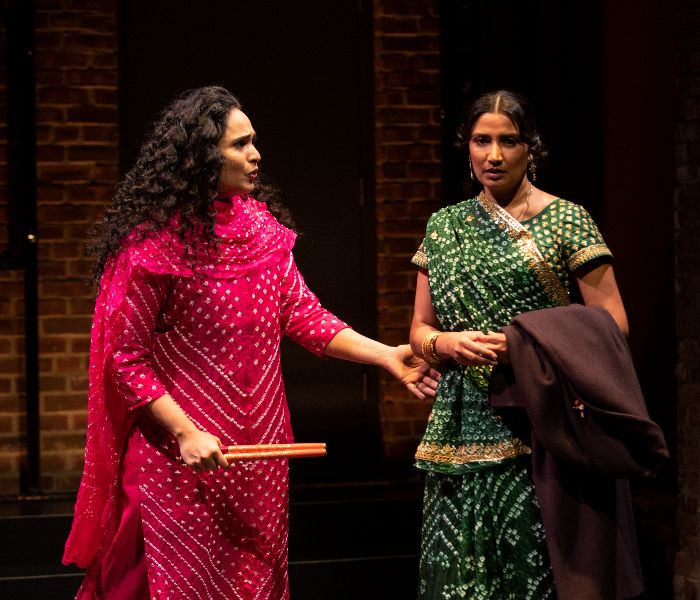
The new play ‘Elyria’ is an immigrant story and a family affair
—
As a veteran writing teacher and the cofounder of the new play incubator Rising Circle Theater Collective, Deepa Purohit has spent decades nurturing aspiring dramatists of color. Now she’s the one in the spotlight with Elyria at Atlantic Theater Company, which marks her Off-Broadway playwriting debut. This world premiere opens with a swirl of Indian music and dance in the title Ohio city as two women unexpectedly reconnect at a cultural celebration. Twenty years earlier in another country, Vasanta (Nilanjana Bose) and Dhatta (Gulshan Mia) had promised to bury an incendiary secret as they went their separate ways. Their surprise meeting in America threatens to dramatically upend their lives.
Although born in the UK, Purohit and her family moved to Elyria, Ohio when she was a child and, in the Playbill, she dedicates the show to “Mom and Dad and all my people who’ve crossed oceans to get to where they need to be.” Considering her parents’ immigration journey helped inspire the story, it’s fitting the production is a family affair. Purohit’s husband, Sanjit De Silva (War Horse on Broadway, Netflix’s Inventing Anna) is in the cast and their longtime family friend Awoye Timpo (Wedding Band, Good Grief) directs. The trio talked with TDF Stages about bringing their ancestors into the room, immigrant strivers and taking inspiration from cultural classics.
Gerard Raymond: Deepa, how much did you draw from your parents’ lives for Elyria?
Deepa Purohit: I wanted to create characters in a world that embodies the many pathways my parents traveled. Their trajectory really started with my grandparents going from their hometowns in India to Africa. My parents were both born in East African countries; they moved together to London when my dad saw an opportunity to further his studies to become a doctor. Then they migrated to America when new opportunities opened up with the 1965 Immigration Act. My parents eventually settled in Ohio where my dad founded his practice.
Raymond: The Midwest is often mischaracterized as all white. But Elyria, Ohio is quite diverse.
Purohit: The media paints small-town America as monochromatic but immigrants are everywhere across this country, even in very rural places. Elyria definitely had a white majority and was very segregated, but there were a lot of immigrants from South Asia and also Black folks. Because of familiarity with food, religion, customs, language and culture, my family migrated to this specific Gujarati community in the town. It’s really like a village within a village. My parents held Gujarati folk dance events, called garbas, every year. This play is about that insular Guajarati world.
Raymond: Sanjit, what’s it like performing in a play written by your wife?
Sanjit De Silva: Deepa and I have cowritten plays together but this is the first time that I’ve acted in a play written solely by her. Even if I wasn’t married to her, I would still be fighting to get in the room to be in this play because she has written such amazing roles. The play is very much the story of America—every small city needed an influx of immigrants to help keep it alive. The story of the migrations, in terms of the South Asian diaspora, is also the story of my family. I grew up in Sri Lanka and then we went to Uganda and then Kenya. As a South Asian actor who has been doing this for 20 years, this is only the second time that I’ve played a South Asian character on stage. It feels very natural to be in this play.
Raymond: What can you tell us about Shiv, the character you play in Elyria?
De Silva: Shiv grew up in Mombasa, Kenya. He’s a sort of hustler businessman and married to one of the main characters. He’s the kind of person who comes to a new country with this desire to do whatever he can to get ahead. I think about my uncle Frank who had multiple kinds of jobs—maybe some of them were a little sketchy—but he had integrity and principles. He was larger than life, a family man with a huge heart. The immigrant experience is about surviving. You have to pick up your life and move one, two, three, four times and, each time, you have to find yourself again. For me, this character is a homage to that side of my family.
Raymond:
Awoye, your friendship with Deepa and Sanjit goes way back and it seems like you are kind of family, too.
Awoye Timpo: It was actually Sanjit who introduced me to Deepa about 10 years ago, and my pathway to Elyria goes back to when we first met. What is so beautiful is there are so many connection points between my story and Deepa’s, and it all developed into this incredible friendship that kept colliding with the world of making art together. I had worked at the Atlantic before [The Homecoming Queen] and they were just completely blown away by this incredible piece by Deepa. All these stars started to align.
Purohit: I saw Awoye’s production of Carnaval by Nikkole Salter, another friend of all of ours, at the National Black Theatre in 2014 and I looked at Sanjit and said, “I need to meet this director.” She has this remarkable vision, an ability to create worlds and amass wonderful creative people on a team. Now I get to experience it firsthand. I started writing Elyria in 2017 and Ma-Yi Theater Company was instrumental in providing a few workshops. But, once the pandemic hit, everything got put on hold. I had just graduated with my MFA in playwrighting from Brooklyn College in 2020 so I was not going to buy into theatre being over. I’d spent two years trying to up my game in middle age, so I kept revising my play. When Awoye asked me for some plays, I was really glad that I had worked on Elyria during that time.
Timpo: We are always learning exciting things about each other. Deepa and I come from families where there are three daughters. My family is from Ghana and they also lived in London for a little bit. We ended up in this small town in the middle of New Jersey. Her dad worked at a hospital in Elyria; my dad worked at a hospital at Princeton. What brings people to a place that is kind of unexpected? How do you raise your children [of color] in an otherwise white suburban town? What do you have to do to ensure they can survive there? When we began our process, Deepa gave us an invitation to bring our ancestors into the room. I think this recent movement to produce plays by artists of color is actually allowing us as artists to honor the people who allowed us to have this life and this possibility.
Raymond: Did this production grow out of the work you’ve done with your own theatre companies, Deepa with Rising Circle Theater Collective and Awoye with Classix?
Timpo: Over the past decade, we as a trio have been in constant conversation about what we dream about creating in the theatre. The mission with Classix is to explode the classical canon through an exploration of works by Black writers. I think that connects to the play that we are making together here. It is exciting to think how Deepa drew inspiration for Elyria from The Little Clay Cart [a seminal 5th-century play from India]. The roots of Sanskrit drama are embedded in this contemporary play. So much of the work that we do at Classix is about how we look back in order to move forward. At the end of the day, that’s what our work in Elyria is—looking back and getting strength and inspiration from those ancestral voices, and thinking about how to manifest that into the future.
Purohit: I wouldn’t have been able to articulate it this way then, but I can say in retrospect that, with Rising Circle, which I started with a friend in 2000, I was interested in taking the whiteness of theatre out of the equation to be able to see what we have. You’re left with people from different communities—that you might define as people of color—who are very, very different, and yet bound by some similarities. What if we were to work with each other without navigating the white majority artistic expression? That’s a complicated and joyful discovery.
De Silva: I joined Rising Circle because there weren’t stories that were being written for us and we had to figure it out ourselves. It is amazing that, 23 years later, Deepa’s play about a specific community is being produced at a major Off-Broadway institution and directed by another first-gen immigrant. We are finally manifesting those dreams of telling these stories.
Purohit: It circles back, Gerard, to your first question about my Mom and Dad. They put on an event every year to bring a community of people together to dance. So, even though doing a production like this isn’t a garba, it’s that essence of building a community of people around artistic expression. I would have never imagined that we’d be doing Gujarati folk dances on a New York stage!
This interview has been lightly edited for length and clarity.
—
TDF MEMBERS: At press time, discount tickets were available for Elyria. Go here to browse all theatre, dance and music offers.
Top image: Nilanjana Bose and Gulshan Mia in Elyria. Photo by Ahron R. Foster.