
How Do You Revitalize a Historic Gay Play?

Tony-nominated director Moisés Kaufman explains why Torch Song is forever relevant
—
Sometimes great theatre minds think alike. That’s what happened when director Moisés Kaufman and playwright Harvey Fierstein each reached out independently to Michael Urie about playing Arnold Beckoff, an adorably neurotic Jewish drag queen looking for love, in separate readings of Torch Song Trilogy. “I had been following Michael’s work and I loved it so much,” recalls Kaufman. “So I called him and said, ‘Let’s sit around my living room and read the play.’ Two days later Michael got a call from Harvey’s manager, who said, ‘Harvey’s been watching your work and why don’t we do a reading?’ Michael said, ‘Moisés just called me and asked the same thing!'” Pretty soon, the three were collaborating on the first major New York revival of Fierstein’s groundbreaking show, which was such a critical and commercial smash at Second Stage Theater in fall 2017, the production transferred to Broadway with the full cast intact for a limited run.
Now known simply as Torch Song, Fierstein’s four-hour epic has been condensed into a pair of fast-paced acts that run under three hours. “Harvey gave me the script fully cut,” Kaufman says. “He knew that a new version of it would have to be edited and shorter.”
No one knows the original text as well as Fierstein — in addition to writing the show, he starred in its various incarnations from 1978 at La MaMa through its Broadway transfer, winning 1983 Tony Awards for Best Play and Best Actor. However, Kaufman can certainly be called a Torch Song superfan. Like Fierstein, the Venezuela-born director is gay and Jewish, and he says catching a production of the show in San Francisco at age 17 was a seminal experience. “I think it really was the first time we got to look at ourselves on stage as anything other than pathetic dramatic figures,” Kaufman remembers. “For me, that was the experience that opened the door and I became possible because I saw that play. I bought the script and took it home. I read it so many times, my mom kept asking, ‘Why do you keep reading that same book over and over?'” Since Kaufman was not yet out, he “stopped reading it — at least in public. It played such an important role in my life. I thought it would be incredible for me to revisit it.”
Both Fierstein and Kaufman knew a revival would only work if they found the right actor to play Arnold, a performer who could go from hilarious to heartbreaking on the turn of a dime-store heel. There’s a reason they both settled on Urie. Though he’s best known to TV watchers for playing over-the-top characters on Ugly Betty and Younger, his stage work has been more nuanced, with roles that required both his comic and dramatic chops, such as Prior Walter in Signature Theatre’s revival of Angels in America, a starstruck employee of Barbra Streisand in the solo show Buyer & Cellar, and playwright Douglas Carter Beane’s stage alter ego in Shows for Days. “Michael is virtuosic — his understanding of the text, his whole body, brain, and being,” says Kaufman. “I know this is going to sound terrible but it’s like working with a Stradivarius. His instrument is so exciting. You’re listening to how the music plays on his instrument and I think Urie is also listening to how the text resonates.”
The fact that the text continues to resonate all these decades later is a testament to Fierstein’s talent and prescience. While it’s definitely a period piece (it was both written and takes place in the ’70s, so AIDS, the subject of so many subsequent gay plays, isn’t even mentioned), it predicted the rise of gay marriage and parenthood decades before they became commonplace. But what really keeps the play fresh is how relatable Arnold’s journey of self-discovery and self-acceptance is — whether you’re gay, straight, or somewhere in between.
“A lot of what Harvey’s talking about in the play is interpersonal relations, and that sounds very contemporary,” Kaufman says. “It’s a play in which a man imagines a world in which he can live the way he wants — a way that everyone is telling him is not possible. To me, that’s universal — it isn’t dusty. Many of us have been in that position with unrequited love or somebody in your family who doesn’t get what you’re trying to create. There is great hopefulness in a man’s ability to craft the life he wants and then executing it.”
—
TDF Members: Go here to browse our latest discounts for theatre, dances, and concerts.
Raven Snook is the Editor of TDF Stages. Follow her at @RavenSnook. Follow TDF at @TDFNYC.
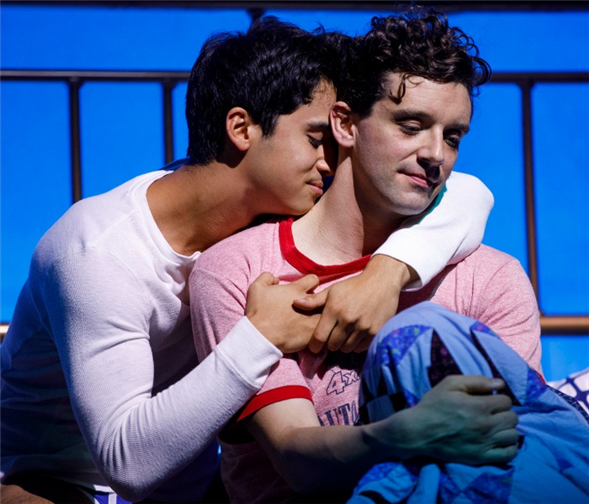
Top image: Michael Rosen and Michael Urie in Torch Song. Photos by Joan Marcus.