
How a Black British Director Is Reinventing an American Classic
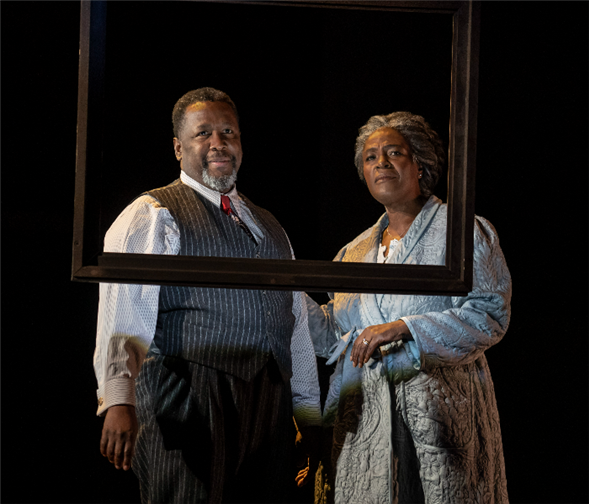
Miranda Cromwell on the impact of centering a Black family in Death of a Salesman on Broadway
—
Miranda Cromwell admits she didn’t think much of Death of a Salesman when she first read Arthur Miller’s iconic play in the early aughts. So it’s remarkable that Cromwell, now 38, is the first person of color to direct a production of the Pulitzer Prize-winning classic on Broadway.
“This play had a lot of white men in it,” explains Cromwell, the London-born daughter of a Black father and a white mother. “It didn’t immediately connect with me.”
She changed her mind when Marianne Elliott, the visionary director Cromwell assisted for six years, insisted her protégée give the tragic story of disillusioned, 63-year-old traveling salesman Willy Loman another shot. Elliott is known for her transformative casting, like her gender-swapped revival of Company, and she urged Cromwell to envision the Lomans as a Black family struggling to access the American Dream after World War II but before the Civil Rights era. “That completely unlocked the play for me,” Cromwell says. “Suddenly I could see my dad as Willy Loman, and it felt so much more immediate.”
When Elliott proposed that they co-direct a production of Salesman for London’s Young Vic starring Black actors as the central family, Cromwell immediately signed on. As she recalls, “I think it kind of broke me reading the play while thinking about my own father,” who died from a brain tumor just before Salesman started rehearsals in 2019. “It also made it clear to me that, wow, there’s a whole world of stories that had been closed to me. And I was really excited about the possibility of opening this play up to other people who may not feel that they can see themselves in the work.”
Aware that they were two Brits taking on the knotty issue of race in America, Cromwell and Elliott embarked on a serious course of study. “We actually employed three different historians over the course of this production,” says Cromwell. “We did a bit of a PhD in African-American history about what this family’s experience would have been, where they would have lived, where they would have gone to school, where Willy would have been selling his goods.”
Still, Cromwell says that only a few words needed to be changed to support their interpretation. For example, in the original script, Willy’s son Biff proudly writes “University of Virginia” on his sneakers because he hopes to get an athletic scholarship there. But that institution wasn’t open to Black students at the time, so Biff’s dream school in this production is UCLA, where Jackie Robinson became the first person to win varsity letters in four sports before going on to integrate Major League Baseball.
Other reconsiderations simply come from the new context. When a waiter leads the Lomans to a table in the backroom of a Midtown Manhattan restaurant, the actors’ body language indicates that it’s not special treatment for a favored customer, but because they can’t sit in the whites-only section. Similarly, when Willy is discovered having an affair, the tension is heightened because a white actress plays his paramour and laws at the time forbid sexual relations across the color line.
The actors’ performances add to the revelations. Wendell Pierce, a NYC stage stalwart who’s best known for his five-season stint as Det. Bunk Moreland on HBO’s The Wire, and Sharon D Clarke, who earned praise in both London and New York for playing the title character in the recent revival of Caroline, or Change, have starred as Willy and his wife Linda since the project’s debut at the Young Vic and its transfer to the West End. Now they’re reprising the roles at NYC’s Hudson Theatre through January 15, 2023—the first Black Lomans in Broadway history.
Pierce’s poignant performance makes clear how the burden of racism adds to the already heavy load that every Willy from Lee J. Cobb to Philip Seymour Hoffman has borne, symbolized by the suitcases he drags through the door at the beginning of the play. But Clarke makes Linda more forceful than she’s usually portrayed.
“Sharon is such a phenomenal powerhouse as an actor and she so fiercely centers love and commitment to her husband,” says Cromwell. “I definitely identify and empathize with the idea of this matriarch who, on the surface, has very little power and control, but actually is one of the most powerful characters in the play.”
While Elliott and Cromwell collaborated on the London mountings, the latter is flying solo as director on Broadway. Aside from Pierce and Clarke, she’s working with an all-new cast, including Khris Davis and McKinley Belcher III as Willy’s sons, and Hadestown Tony winner André De Shields as his older brother. “It’s been the biggest challenge—it’s my Everest for sure, but it’s been a very empowering experience,” Cromwell says. “It has really come out of a desire to illuminate this beautiful text in a universal way. It’s not about adding anything on; it’s about pulling something out from within it.”
—
TDF MEMBERS: At press time, discount tickets were available for Death of a Salesman. Go here to browse our latest discounts for dance, theatre and concerts.
Janice C. Simpson writes the blog Broadway & Me and hosts the BroadwayRadio podcasts All the Drama and Stagecraft.
Top image: Wendell Pierce and Sharon D Clarke in Death of a Salesman on Broadway. Photo by Joan Marcus.