
Has Sibling Rivalry Always Been the Same?
The Mint Theater’s revival of a 98-year-old play makes a strong case
—
The old adage “the more things change, the more they stay the same” is always on dramatic display at the Mint Theater Company, which is dedicated to resuscitating lost or neglected plays from the past. Though industry, fashion, and social mores may transform, human nature remains remarkably consistent.
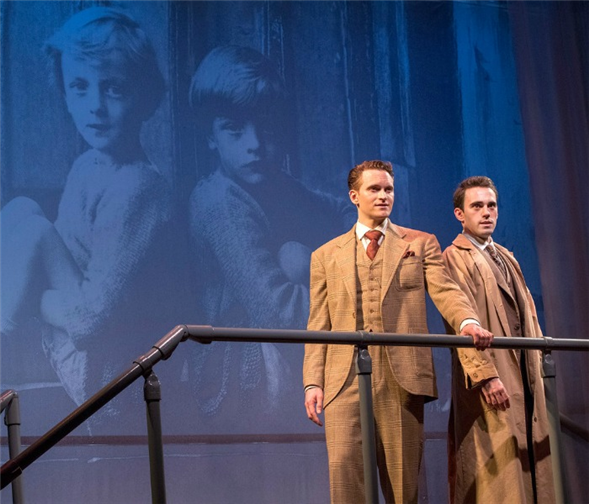
Take sibling rivalry, which is at the heart of The Lucky One, an almost century-old dramedy that feels surprisingly fresh. Written in 1919 by A.A. Milne (yes, the beloved author of Winnie-the-Pooh), it was staged briefly on Broadway in 1922 and then virtual disappeared until this Mint revival. Reportedly semi-autobiographical, the play examines the relationship between two brothers: Gerald (Robert David Grant), the golden boy, and Bob (Ari Brand), who lives in his sibling’s shadow. Legal troubles and a love triangle unleash decades of resentment between the two, shattering their repressed sensibilities.
When Jesse Marchese, the play’s director, first read the script, he was floored by how relatable it was. “Even though the play is almost 100-years old, it’s so psychologically keen,” he says. “I have two siblings and I recognized the way these boys talked to each other. I felt like Milne got it so right. He knows the language that siblings speak.”
The Mint, where Marchese serves as associate director, has staged two of Milne’s other plays: Mr. Pim Passes By and The Truth About Blayds. However, despite 15 of Milne’s shows making it to Broadway during his lifetime, most have been forgotten.
“There are so many playwrights — Milne, Rachel Crothers, George Kelly — that had huge successes and now their work just doesn’t get done,” Marchese says. “It’s part of the ephemeral nature of the business. Theatre is a fleeting thing. There’s a very interesting quote from Milne himself that speaks to this beautifully: ‘A puff of foul criticism, a week of fog, a few days of crisis, a bus strike, the sudden indisposition of the leading man may be enough to sink a play forever.’ He knew that there’s an arbitrary nature to success in the theatre.”
For Marchese, directing a play that hasn’t been staged in 95 years is akin to working on a brand-new show — but without the ability to consult the playwright. “It’s liberating in a way because your only goal is to tell the story honestly and with respect to the playwright,” he says. “The real challenge of a play like this is that it’s dialogue-driven and rather delicate. We spent a lot of time sitting at the table talking about the play, about the relationships, trying to figure out the years of history between these characters.”
Set in early 20th-century England, The Lucky One explores the nature of that fragile society, where expressing feelings openly and honestly was not the order of the day. Marchese was careful to modulate the level of passion for the emotionally fraught scenes — after all, it’s not Eugene O’Neill. “A lot of times we learned to underplay it,” he says. “What happens if the actor resists the temptation to show how they feel? There’s a line where a character says, ‘You broke my heart,’ and I had the actor try it with a smile. What if you choose to push those feelings down and bottle them all up? Does it make the play even more heartbreaking?”
Marchese hopes that audiences will be so moved by what transpires between these brothers that they’ll exit reflecting on their own familial relationships. “I hope people think, maybe I should give my brother a call,” he says. “If someone leaves the theatre thinking that, then we’ve made our case for this beautiful little play.”
—
TDF MEMBERS: At press time, discount tickets were available for The Lucky One. Go here to browse our current offers.
Follow Haley Chouinard at @HaleyChouinard. Follow TDF at @TDFNYC.
Top image: Robert David Grant and Ari Brand. Photos by Richard Termine.