
Finding the Personal in the Political
How one social justice theatre company uses real-life stories to inspire its art
—
Last summer, Houses on the Moon, a socially focused, community-committed theatre company, began developing a pair of projects about gun violence. Now, with the subject seemingly in the zeitgeist on stage (On the Exhale, Church & State, and When It’s You are just a handful of the other productions that have wrestled with this incendiary issue this season), the troupe is presenting Camilo Almonacid’s world premiere play The Assignment in rep with gUN COUNTRY, an evening of true stories by people whose lives have been impacted by guns. (Co-produced by the hip-hop and theatre artist collective Rhymes Over Beats, the projects are at the A.R.T./New York Theatres. The Assignment plays through May 7, and gUN COUNTRY plays through May 3.)
Founded in 2001 by Emily Joy Weiner and Jeffrey Solomon, Houses on the Moon has always explored controversial topics in its work, including immigration, eating disorders, adolescent sexuality, and bullying. But thanks to a recent infusion of funding, new collaborators, and a legit Off-Broadway venue, The Assignment is the company’s highest-profile offering to date.
The company’s theatre-making process is meticulous. The artists build stories over time with people touched by a particular social issue through interviews and writing groups. “It’s really important to me that our work never tells you what you’re supposed to think,” says Weiner, who directs The Assignment. “We explore very liberal concepts and issues, but it’s important that we have a spectrum of stories trying to come from a human point of view.”
Jenna Worsham, who directs gUN COUNTRY, concurs. “In theatre, we often curtail stories to have the most political impact, sometimes to the point that it isolates and polarizes audiences,” she says. “What Houses on the Moon does radically well is that they always put the story first. They let the person say whatever they want to say. They trust that the personal is inherently political, and that if you take a group of people who think differently, as we do in gUN COUNTRY, and put them in conversations together, it ends up breeding discussions better than some really well-constructed play that might have only one perspective.”
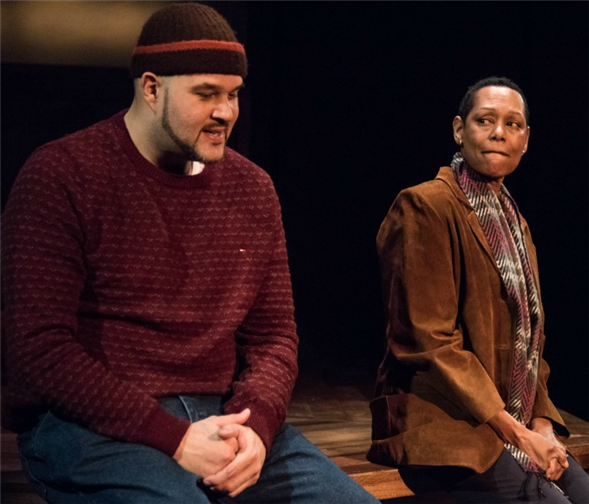
The Assignment is a two-hander about an ex-con and his college English professor whose lives were altered by gun violence. The play’s plot was inspired by true stories that emerged during a gun-violence writing group facilitated by Houses on the Moon. Karen Kandel, the actress playing the professor, is the co-artistic director of Mabou Mines and a busy Off-Broadway performer. “She’s the experimental theatre world’s queen!” says Weiner. “I couldn’t have done a casting call and gotten her. I met her through a friend who knew what I was really looking for. Karen and I sat down for coffee a year and a half ago and — seven hours later — we were at my house drinking wine. She cancelled two international trips for other projects so she could do it.” Meanwhile, Erick Betancourt, who plays the ex-con, returned to school in his twenties and graduated a year ago with an MFA. Somehow, Houses on the Moon always finds the people with passion for the parts. “These guys are giving their souls to this project,” says Weiner.
gUN COUNTRY marks the first time someone other than one of Houses on the Moon’s original co-founders has directed one of its pieces. Worsham has been working with the company for several years in various capacities, including assistant director and writer. “I fell in love with them years ago when they were developing something with Lucy Thurber,” Worsham recalls. “They were working on a new play that dealt with eating disorders. I was pretty new to the city and Lucy [whom Worsham married last year], got me involved. They do this pretty awesome interview process, get people’s stories and develop art out of them. It really had an impact on what would become my process as both an activist and a director, dealing with non-artist performers and non-artist storytellers.” When the gun violence writing group came along, Worsham shared her own tale of growing up around firearms, revealing her as the ideal director for the job.
Jane Dubin, a Houses on the Moon producer and board member, admits that gUN COUNTRY wasn’t initially part of the production slate. “When the project began, the idea was to create a play,” she says. “I don’t think they realized that the gUN COUNTRY aspect of it would be such a powerful evening of performance. I said to them, ‘You know, you have to keep doing this. It’s not a means to an end; it’s an end unto itself.'” Of course, the blending of professional and amateur storytellers creates challenges along with opportunities. For gUN COUNTRY, all of the performers save one have lived through the experiences they describe. “It’s meant to be theatrical storytelling, not acting,” says Worsham. “I tended to be really hard on the actors,” she recalls, telling them, “‘Go back to that moment and be there in it and experience it again.'” She worked with them to remove the performer’s lens.
Even though Houses on the Moon’s personal process sometimes drudges up pain, Weiner believes the payoff is worth it. “When you really commit yourself in a real place, a truthful place, you begin to give more,” she says. “I’ve never found one moment in our work where it was like, ah, that wasn’t worth it. Now we’re at the point where we’re going to be able to reach a lot more people. We want to, because we believe in what we’re doing.” Worsham agrees. “The part that they love the most isn’t a big opening night or press. Their favorite moment is going into a mental health center and talking to someone who had an eating disorder and getting them to tell their story,” she says. “They’re more interested in giving visibility on that individual level, knowing that those smaller revolutions within people accumulate and have impacts that echo in a community in ways that make a real difference.”
—
Follow Martha Wade Steketee at @MSteketee. Follow TDF at @TDFNYC.
Top image: Erick Betancourt and Karen Kandel in The Assignment. Photos by Russ Rowland.
TDF MEMBERS: Browse our discounted tickets to theatre, dance, and concerts.