
Despite Strides in Accessibility, I Often Feel Othered at Broadway Shows
It’s frustrating to be left out of theatrical fun because I use a wheelchair
—
In 2019, when Oklahoma! opened at Broadway’s Circle in the Square Theatre with a star who needed wheelchair accessible accommodations to get on stage, I was excited to see it. Being a wheelchair user myself, representation is incredibly important to me. I went with another wheelchair user who was equally eager to see Ali Stroker in action. We had heard that at intermission, theatregoers were invited on stage to grab a snack, and we hoped we would get to enjoy that unique experience. We could not. The stage remained inaccessible to us from the audience. The production did send over a staffer who offered to bring us food, but the barrier remained. It was such a sad consolation prize from a show doing so many great things. Worse, it reminded me of the first time I felt othered at a Broadway theatre.
It was 1994. I was 12 and Rosie O’Donnell was starring in Grease at the Eugene O’Neill Theatre. I remember going with my mom and my cousin. I also recall the onstage dance party I could not participate in. I danced in my seat instead, but I was green with envy at all those who were partying on a pedestal. I didn’t understand why that part of the show was not meant for me.
In 2012, it happened again. I was all grown up, working in the theatre industry and, frankly, accustomed to disappointment by then. My mom and I went to Broadway’s Bernard B. Jacobs Theatre to see the musical Once, which invited audiences to mingle with the musicians and grab a drink at the onstage bar. I told my mom to go without me—it’s a thrill to be able to go on stage and I wanted her to experience it, even if I couldn’t. Of course, I didn’t really want to be left alone.
I have had the pleasure of being on a Broadway stage, but I’ve never gotten there from the audience. Clearly, this isn’t a problem that theatres seem particularly concerned about. At the 2019 Tony Awards, Ali Stroker had to be brought backstage at Radio City Music Hall while she waited to hear whether she won for her performance in Oklahoma! Otherwise, she wouldn’t have been able to access the stage to accept her statuette. Ultimately, she made history as the first performer who uses a wheelchair to win a Tony. But she couldn’t celebrate that triumph among her peers like all the other winners do while making their ascent to the stage from the audience. I’m sure she felt mixed emotions.
Sometimes the challenges wheelchair users face aren’t about spaces but about the attitudes of the people managing them. In my decades of theatregoing, I’ve encountered box office personnel who refused to sell me tickets or spoke to my companions instead of me. Ushers who pointed me to my wheelchair location as if landing a plane. A general disconnect between those who wrote the ADA ticketing guidelines and those who implement them.
Name any theatre in NYC and I’ve got a story for it. When I was in college, some shows such as Rent, The Rocky Horror Show and Jekyll & Hyde gave me wheelchair locations at student rush, lottery or even lower prices. I was a student after all, which, for what it’s worth, is how I think the ADA is meant to be interpreted, but that wasn’t the case at every show. Today, it’s most common for wheelchair locations to be offered at mezzanine prices.
One of my worst theatre memories was attempting to buy tickets to Rock of Ages at the Helen Hayes Theater. The box office entrance was not accessible—it had an exterior step leading to the door. Inside, the ticketing windows didn’t face the street, so I couldn’t get anyone’s attention from outside. No doorbell, no public phone number. I called the show’s ticket hotline, but the rep wanted to charge me a service fee to order tickets through him and wouldn’t connect me with someone in the box office I was literally in front of. It was the pure definition of discrimination. Trying to flag down a Good Samaritan in Midtown was tough. People averted their eyes, assuming I was asking for money or food. Eventually, another ticket buyer went inside and grabbed a treasurer for me. Despite my frustration, I still bought tickets, but I haven’t been back to that venue since. In 2015, the theatre was purchased by Second Stage and the company has made renovations to improve accessibility. There’s a flat exterior now, a push button to automatically open the front door, plus a posted phone number. That main entrance still has steps once inside, but it’s a vast improvement.
Several barriers to access on Broadway have been tackled in my lifetime—on-demand captions in GalaPro; the existence of a centralized website for accessible theatre information, which I helped create; better training for staff. Recently, I was happy to read about the upcoming accessibility improvements at Jujamcyn Theaters, even though they were prompted by a lawsuit. Yet I continue to dream about advancements in inclusion that too few even consider.
I am willing to concede that physical barriers in largely landmarked theatres are harder to address than clueless human behavior. But theatres have been closed for more than a year and it seems like such a missed opportunity that so few accessibility issues were fixed. There are still theatres where the closest accessible bathroom is in another venue across the street. Spaces where the only wheelchair accessible entrance is down an alley past the garbage, or around the corner through an office building. And there are little kids with disabilities in the audience longing to be able to get up on stage. We can do so much better.
—
Christina Trivigno is the Director of Digital Strategy for TDF. She has more than 10 years of experience working in the digital space and a lifetime of experience as a disability advocate. She has spoken and written about accessibility at organizations around the country, addressing topics such as transportation, reasonable accommodation, digital accessibility and access at the theatre. She was proud to marry her passions with the launch of TheatreAccess.NYC.
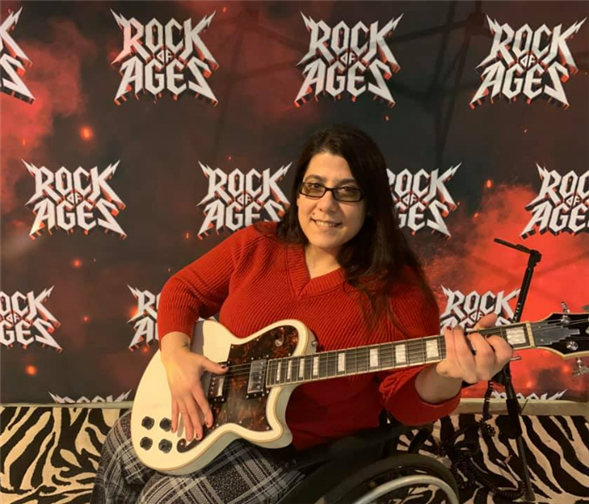
Top image: The author at Rock of Ages when the show was at New World Stages. Photo courtesy of Christina Trivigno.