
Creating Costumes in a Giant Ape’s Shadow

Tony-winning designer Roger Kirk returns to Broadway with King Kong
—
Costume designer Roger Kirk didn’t have to worry about dressing the title character for King Kong on Broadway. Apes don’t wear clothes, even when a massive animatronic one is the star of the show. But the Tony winner faced many other challenges crafting the hundreds of costumes for this $35 million musical spectacle, which has been in development for the better part of a decade.
The Australian production company Global Creatures launched the project in 2010, and Kirk was brought on by the original director, Daniel Kramer, who helmed its 2013 world premiere at Melbourne’s Regent Theatre in anticipation of a quick Broadway transfer. Instead, the show spent the next five years being retooled. Kramer and the original book writer, Craig Lucas, left and a series of bigwigs (Pulitzer Prize-winning playwright Marsha Norman, Tony-winning director John Rando, Tony-winning songwriter Jason Robert Brown) cycled through. The only creatives who have ultimately made the journey from Oz to New York City are composer Marius de Vries and the design team, including Kirk, who won Australia’s equivalent of the Tony for his work on the Melbourne mounting.
Of course most of the costumes he designed for that incarnation are now long gone, shipped off to storage or repurposed into new outfits. That’s what happens when you have a new script by Jack Thorne (Harry Potter and the Cursed Child) and a new director-choreographer, Drew McOnie. A fresh vision means lots of changes but, in a way, that’s been the creative process of King Kong all along.
“When I first started with Daniel there was no script, and I felt like he used me as a bit of a sounding board,” recalls Kirk. “He’d talk about something and I’d do some drawings and I’d go to a meeting the next day and they’d go, ‘Oh no — we’re not doing that anymore.’ So after a while learned not to draw. It was such a long process over many years. Luckily I was asked to stay with it.”
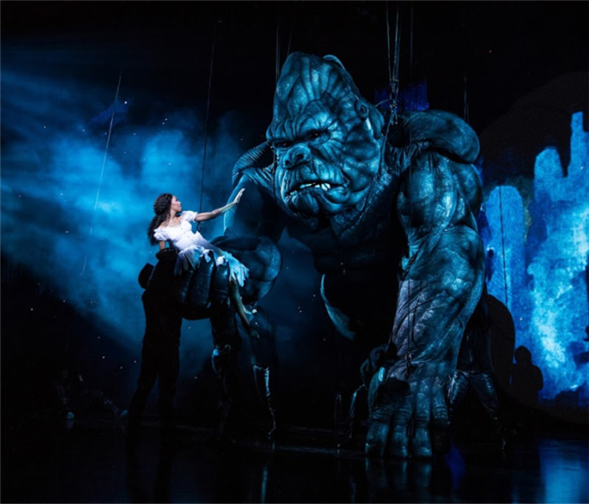
Although King Kong features cutting-edge technology, a pop-theatre score and a contemporary sensibility, it’s set during the Great Depression. Like the eponymous 1933 film that serves as its template, the production primarily uses a black-and-white color palette, with Kirk’s costumes often supplying the only bursts of color. Yet he chose to clothe King Kong’s object of affection, Ann Darrow (played by Christiani Pitts) almost always in white, so she would pop against the massive silverback puppet.
“She has to do so much and be the center of attention,” Kirk says. “Even on Skull Island [where they find King Kong], you want her to stand out even though it’s dimly lit. So it was a very conscious decision to put her in white.”
Of course the white gowns the heroine wears are far from plain, as expected from a designer known for crafting lavish period garments. Born in New South Wales, Australia in 1947, Kirk developed an interest in design as a young man and has worked in theatre in his homeland, on the West End and on Broadway. He won a Tony for the 1996 revival of The King and I and was nominated for the 2001 revival of 42nd Street, another tuner inspired by a 1933 black-and-white movie. There’s a scene in King Kong when Pitts, decked out in white robe trimmed with feathers, peruses a wardrobe filled with fetching outfits that would look right at home in the current London revival of 42nd Street, which Kirk also designed.
But Kirk is pragmatic about his role in King Kong. He realizes audiences are there to marvel at the incredibly lifelike, 20-foot tall, 1.2-ton puppet — not his costumes. “If you do a movie and you dress a thousand extras in rags, people don’t realize the work that’s gone into it,” he says. “This show has become a bit like that. We’ve kept the color palette low. I’ve just tried to punch through the grey a bit.”
He’s also made sure his costumes are functional, not an easy task considering the number of quick changes. “Every time something in the show gets chopped or tightened it affects everything you do,” Kirk says. “There’s been more script changes in this show than anything I’ve ever done! Thirty seconds is usually what you have for a quick change, but in this show it’s shorter. The girls who go out in front of the curtain when King Kong breaks free, they have 10 seconds to get into the next costume for the rampage, which they originally weren’t in. So I had to rethink things.”
Happily, he only had to do the redesigning, not the restitching. “To be perfectly honest I don’t sew!” Kirk admits. “Years ago when I first started out, a girl I grew up with had a costume workshop. She told me, ‘Roger, never learn to sew. As soon as you learn, you’ll be behind the machine and never design again.’ So I never learned. It was great advice!”
Despite all the costume drama, Kirk is thrilled to be back on Broadway after 17 years, working on a show that may be one of his last. “I am thinking of retiring because I’m getting a bit too old for this,” he says. “It’s been a long haul but it’s good to see the show finally here in, I think, pretty good shape. The puppet alone is worth coming for. It’s a good team to work with because it has been quite hard at times but everyone gets on really well. And that’s half the battle, isn’t it?”
To read about a student’s experience at King Kong, check out this post on TDF’s sister site SEEN.
—
Raven Snook is the Editor of TDF Stages. Follow her at @RavenSnook. Follow TDF at @TDFNYC.
Top image: Christiani Pitts in King Kong. Photos by Matthew Murphy.
TDF MEMBERS: Go here to browse our latest discounts for dance, theatre and concerts.