
Bringing Bad Back
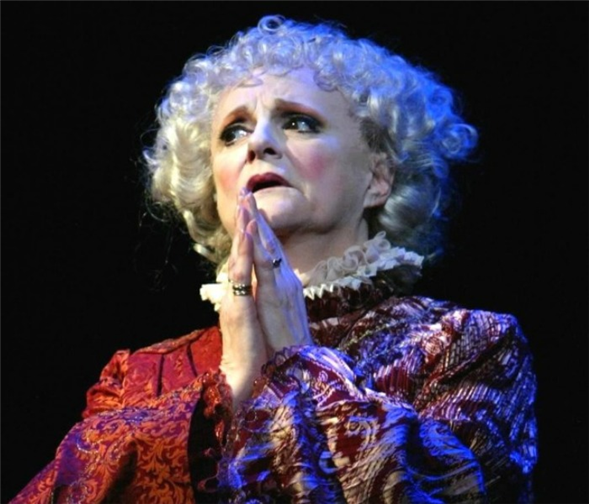
Carole Shelley, who created Madame Morrible, returns to the only truly wicked role in ‘Wicked’
—
The hook of the runaway Broadway smash Wicked is that it humanizes and explains the actions of major characters in L. Frank Baum’s The Wizard of Oz, making the piece’s villains into misunderstood antiheroes and the original heroes into flawed, compromised, even craven figures.
But every story needs a good villain. And while Wicked handily overturns our perceptions of the Wicked Witch, the Wizard and the Tin Man, et al, its most important additional character is a doozy of a dowager: the imperious, beehive-wigged schoolmaster Madame Morrible, who leads the young charges of Shiz University with a blend of matronly charm, icy manipulation and a shadowy secrecy worthy of Dick Cheney.
And now, nearly four years after creating the role on Broadway, Tony winner Carole Shelley has re-donned the wig and bustle to strut and fret as Wicked‘s wickedest specimen.
“It’s a nicely important role in the story line,” says Shelley with a degree of modest understatement. “And it was terribly exciting to be in it at the very beginning. It was sometimes a little nerve-racking; it can be difficult to keep up. When they get going with a big show like this, they really expect you to deliver it yesterday.”
When the part came up, she was called by the producers and asked if she’d like to audition. “I said, ‘I wouldn’t like to audition, but I guess I’ll have to,'” Shelley says with an expansive laugh that’s just a pitch shy of a contented cackle. “I had read Gregory Maguire’s book [upon which the musical is based] and adored it. But when I went to meet with them, the script wasn’t in a finalized place.”
Today, with the benefit of hindsight, the nerves and uncertainty seem to have been well worth it. Wicked is a gold-plated sellout wherever it goes. Did Shelley have any inkling that this would be the phenom that it is?
“One knew that it could be something special,” Shelley says. “But the script was changed mightily between the San Francisco tryout and the New York opening. We all took a two-month hiatus while the writers did all the rewriting. I mean, I knew that the subject matter was just dynamite, but who’d ever think it would go over like this?”
Shelley herself has gone over well in the States ever since the 1965 Broadway production of The Odd Couple, in which she played one of the attractive English sisters, the Pigeons (“Yeah, I’m an old pigeon,” Shelley jokes). The London native was immediately smitten with our country.
“I decided to stay immediately — I took out papers within minutes of arriving,” Shelley recalls. In the early ’90s, she became a U.S. citizen because she says she “desperately wanted to vote.” And while she’s been back to the U.K. many times, she says she always feels, ” ‘Oh, let me get home as quickly as possible.’ And home is New York. I’ve lived here longer than I lived in England.”
Her accent, used to sharp effect in Wicked, is that plummy but accessible blend that’s often called “mid-Atlantic” — an odd term, Shelley feels, that makes it sound “like you’ve been dropped down in the middle of the ocean.”
Just as she’s moved with ease between continents, she’s also segued seamlessly between British classics and straight plays on the one hand, and Broadway musicals on the other. Her 1979 Best Actress Tony was for The Elephant Man, and she had a previous nomination for Alan Ayckbourn’s Absurd Person Singular, but when she was nominated again in 1987, it was for her role in the musical Stepping Out. She recently played a dream role, Lady Bracknell in The Importance of Being Earnest, in the Berkshires (“I discovered I am Lady Bracknell,” she says, “and it’s devastating when you find out you’re a Gorgon, albeit a sympathetic one”).
“The classical work put me in very good stead for Morrible,” Shelley says. “She’s a bit of a drama queen, and a bit like a character out of Restoration Comedy. She represents herself differently to different people, and she’s power hungry. How she uses that power I find really interesting.”
After the opening, she stayed with the show for more than two years, and “it knocked me out, I’ve gotta be honest. By the time I left I felt totally burned out. Shakespeare is pretty exhausting, too, but Morrible takes a heck of a lot of energy. There is a certain driving element to her character, because she’s manipulating a lot of characters and events. Her intense spontaneity takes a lot of energy.”
How does Shelley sustain that level every night? “You start the show and allow whatever happens to happen. It’s the same jungle gym, you just swing different ways — crikey, that’s a terrible analogy!” she says with a self-deprecating laugh. She tries again: “I pull myself into it, think of who I am, and then I let the play happen. I don’t set out to make the play different every night. But if something happens, you have to respond differently. Last night, in the part where Nessarose’s wheelchair takes off and starts spinning, the bloody wheelchair started heading for the orchestra pit. We were all screaming. That was a truthful moment!”
And how long will Shelley run with Morrible this time out?
“I think I’m in — it sounds like a prison sentence — for 4 ½ months,” Shelley says. “I’m out early for good behavior.”
—
Top image: Carole Shelley in Wicked on Broadway. Photo by Joan Marcus.
TDF MEMBERS: Go here to browse our latest discounts for dance, theatre, and concerts.