
A Year Ago, She Was Leaving the Business. Now She’s Starring in ‘Six’ on Broadway

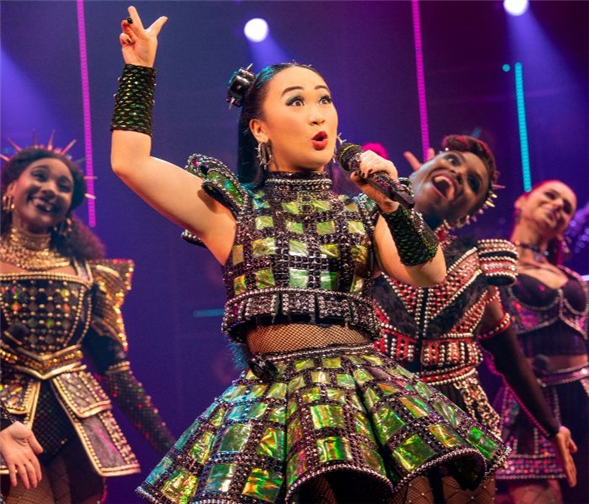
How the role of Anne Boleyn changed Andrea Macasaet’s life
—
An impromptu trip to an open call landed Andrea Macasaet in the cast of Six, a feminist pop musical about King Henry VIII’s ill-fated wives. But even after snagging the role of Anne Boleyn for the 2019 Chicago production, Macasaet had no idea she would end up traveling with the show to New York. Now she’s making her Broadway debut as the misogynistic monarch’s second spouse, performing to an audience filled with impassioned fans, many of whom know the songs by heart thanks to its studio cast recording, which has been streamed more than 100 million times.
Just a year ago, Broadway didn’t seem to be in the cards for the Filipino Canadian actress; in fact, she wasn’t pursuing performing at all. “I was taking a little break from theatre,” she says, adding that she was taking classes in human resource management and considering a career change. But when she saw the audition notice for an all-women musical in the style of the Spice Girls, she was intrigued. Macasaet bought a plane ticket to Toronto to attend, even though she was nonunion and had no agent. She got two callbacks before being summoned to Chicago, where she sang for both Anne Boleyn and Jane Seymour—two drastically different parts. “I guess the rest is history!” she says.
Six has an equally against-all-odds backstory. Written by Toby Marlow and Lucy Moss while they were students at Cambridge University, the musical went from the Edinburgh Festival Fringe to Broadway in just three years, with multiple stops along the way. It’s become a global sensation, with other productions of Six on London’s West End, touring Australia and New Zealand, and running on Norwegian Cruise Lines. The U.S. incarnation started at Chicago’s Shakespeare Theater, then played a few other regional venues before bowing at the Brooks Atkinson Theatre, where it’s making history. At 26, Moss, who co-helms the production with Jamie Armitage, is the youngest woman ever to direct a musical on Broadway.
Six is presented as a concert-cum-competition during which each spouse sings about her suffering, with the most tormented queen crowned the group’s lead singer. Considering their fates—“divorced, beheaded, died, divorced, beheaded, survived”—they’ve got a lot to croon about. The score features powerful group numbers alongside showstopping solos, with the characters evoking a constellation of pop stars. Beyoncé, Adele, Ariana Grande and Nicki Minaj are some of the divas reflected in the songs and aesthetics.
Macasaet’s Anne Boleyn shares her story of woe through the cheekily titled number “Don’t Lose Ur Head.” With each chorus of “sorry, not sorry,” she recalls the chaos that ensued after Henry left his first wife and broke with the Catholic Church to marry her; just three years later he accused Anne Boleyn of treason and had her beheaded.
Since Anne Boleyn has been the subject of numerous films and books, she’s arguably Henry’s highest profile wife. Macasaet loves that the way the character is written in Six challenges preexisting notions.
“She is the queen that everybody knows, and there’s this expectation of who she might be,” Macasaet says. “She’s this big historical figure and she was made out to be a witch and manipulative, and we wanted to take all of that and flip the narrative. What if it wasn’t like that? What if Anne was just go with the flow and kind of landed where she was? What does that look like from a woman’s perspective, being open to opportunities and then being judged a certain way because she was so bold and outgoing?”
While studying Anne Boleyn, Macasaet grew to appreciate the depth of her personality, her cunning and her strength. “She was well educated, she learned about fashion, she knew about music,” Macasaet says. “She was smart and she was quirky, and she knew how to carry conversation. When she clocked that Henry wasn’t happy with her anymore, she tried to cover her bases. In protecting herself, it ended badly for her—but you do that now [stand up for yourself] as a woman and it’s life-changing. We get to showcase her in a light that celebrates her fierceness and boldness.”
Audiences, especially young ones, are clearly enthralled by all the girl power on stage. In addition to being tagged in fan art and emulated in TikTok videos, Macasaet often spies cosplayers dressed as her character. At one performance at American Repertory Theater in Massachusetts, she saw three different Anne Boleyns in the house.
“They go crazy, and it’s so fun,” she says. “I love what these people come up with. It’s mind-blowing.”
She suspects part of the appeal is Six‘s diverse cast: a half dozen women of various backgrounds and body types. “You have queens of different sizes and shapes and heights and colors,” Macasaet says, so fans can “find themselves represented in each of us. I think that’s what’s inspiring about this queendom—there isn’t just one type of person who can play a queen. We’re every woman.”
—
Carey Purcell writes about pop culture and politics for Vanity Fair, Politico and other publications, and blogs at CareyPurcell.com. She recently published her first book: From Aphra Behn to Fun Home: A Cultural History of Feminist Theater.
Top image: Andrea Macasaet (center) in Six on Broadway. Photos by Joan Marcus.
TDF MEMBERS: Go here to browse our latest discounts for dance, theatre and concerts.