
A Brief History of Sex
By DIEP TRAN
Playwright Chiara Atik does not like watching sex. On stage at least. “I always get uncomfortable and immediately start thinking, ‘Oh I wonder if the actor’s mom is here,'” she says. “It takes me out of the moment.” Knowing that, it’s ironic that her play Five Times in One Night is entirely about the beast with two backs.
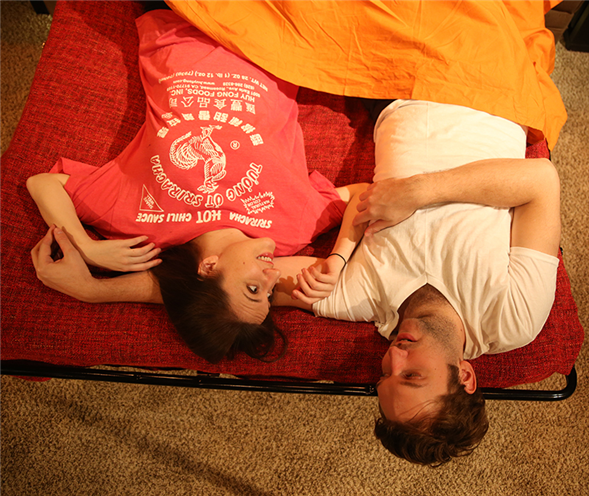
“I wrote the play to see if I could write about sex for the stage in a way that didn’t make me uncomfortable,” she explains of the show, which runs as part of Ensemble Studio Theatre’s Youngblood series through March 14. Indeed, despite its athletic-sounding title,Five Times does not feature five sex scenes. Instead, it’s five separate, two-person short plays that deal with the build-up to coupling and the baggage around it.
“There’s way more talking about sex in the play rather than the actual sex,” Atik says. “For me, it’s an exploration of sex and intimacy. And how sex can be really awkward, and how it’s hard to talk about, and how it changes the relationship of the person you’re with.”
Atik wrote Five Times after a short stint as the love and lust editor at Cosmopolitan magazine, and one of the segments in Five Times, where a woman is trying to convince her boyfriend to choke her, was directly inspired by “Cosmo” readers. Trying to communicate sexual needs “was something a lot of women were writing in about and struggling with,” the playwright says.
But aside from the modern dating segments, Five Times is also an exploration of how sex has changed, or not changed, throughout human history. There’s a scene about the first copulation of Adam and Eve and another about the last man and woman on Earth. “The notion of a selected history of sexual relations, that just seemed so funny,” says Graeme Gillis, co-artistic director of EST/Youngblood. “And Chiara’s writing is so appealing and pliable. It felt effortless to put it up. ”
Atik, 29 years old, is in her fourth year in Youngblood, EST’s early-career playwrights program that develops work by writers under 30. Every season, EST devotes one of its production slots to a play from a Youngblood writer, and Atik’s show joins a legacy that includes Year of the Rooster by Eric Dufault and Hand to God by Robert Askins (which begins Broadway performances March 14).
When asked if he takes credit for discovering Askins, Gillis deadpans: “We found [him] on a snow bank. We fed him, and he just stayed. And somewhere along the line we found out he could write.”
If the answer sounds hyperbolic, that’s the point. Whereas EST is the laid-back parent, Youngblood is the sarcastic, hipster child who will say “screw it” and try anything once. That was the case with the demonic sock puppet in Hand to God and now with Five Times, where audiences are invited to buy a beer and watch the show while lounging on couches. “It’s [like] us sitting around talking about weird dates that we have,” says R.J. Tolan, co-artistic director of Youngblood and director of Five Nights. “We sit at [Youngblood] meetings and talk about weird dates.”
There are currently 27 playwrights on the Youngblood roster (with three to nine new members added annually, from over 200 applications). Besides production opportunities, Youngblood also offers weekly meetings, workshops, readings, and retreats. There is no limit to how long a playwright can be in Youngblood (the record-holder was Edith L. Freni, who stayed for 11 years), though playwrights “graduate” (or are “kicked out”) when they turn 30. Other Youngblood alumni include luminaries like Annie Baker, <a href=”http://wp.tdf.org/index.php/2012/12/amy-herzog-the-great-god-pan/” target=”_blank”>Amy Herzog</a>, and <a href=”http://wp.tdf.org/index.php/2015/02/lucy-thurber-the-insurgents-labyrinth-theater/” target=”_blank”>Lucy Thurber</a>.
And while a production is not a guarantee, all playwrights get readings, workshop productions, and chances to write for Youngblood’s short play festivals. “Somebody’s going to see [your play],” Tolan says. “And you’re going to watch people watch it and get feedback from the audience. It’s not being written to be read; it’s being written to be performed.”
Atik says that being forced to consistently write and bring in pages for feedback has upped her game considerably. “I write completely differently now because I’ve been inspired by the people in the group,” she explains. “I find myself wanting to write better and cooler and push the envelope more and do different things, because the people I was with were better and cooler and doing different things.”
Demonic sock puppets, cockfighting, and a history of sex: that’s just a small snapshot of the off-kilter subject matter undertaken by Youngblood playwrights. For Atik, that’s why it’s fun. “The voices tend to be exciting, with a vitality and a hunger and a verve and an eagerness,” she says. “And really wanting to show [audiences] something new.”
—
Diep Tran is a writer and editor based in New York City
Photo by Gerry Goodstein